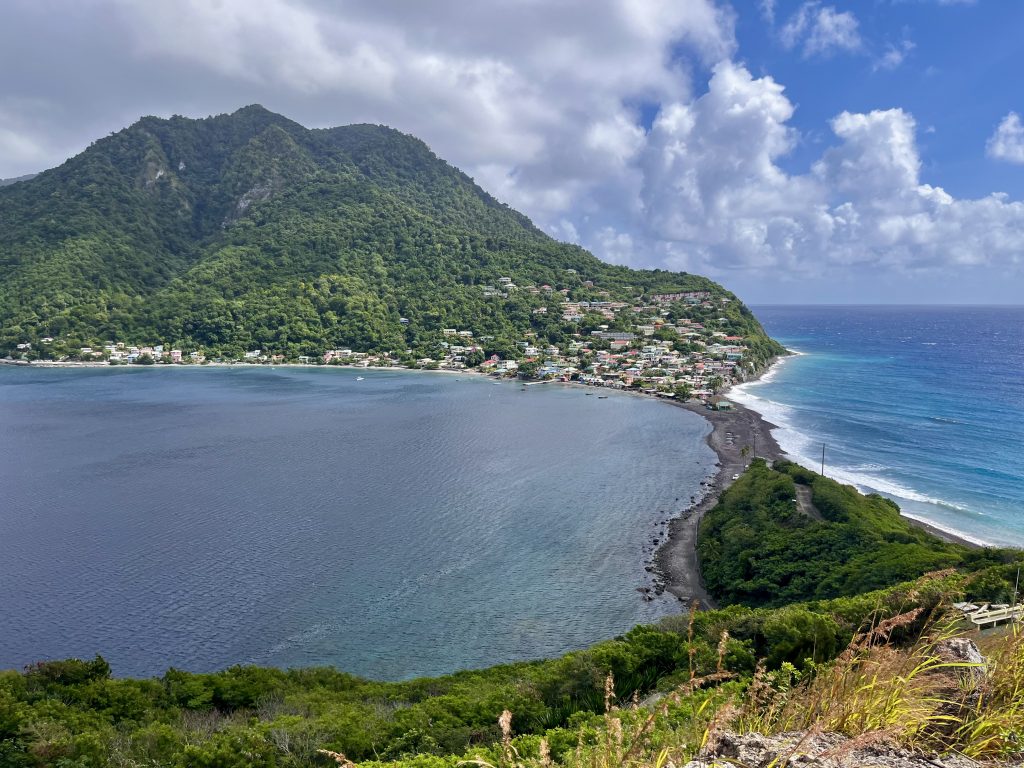
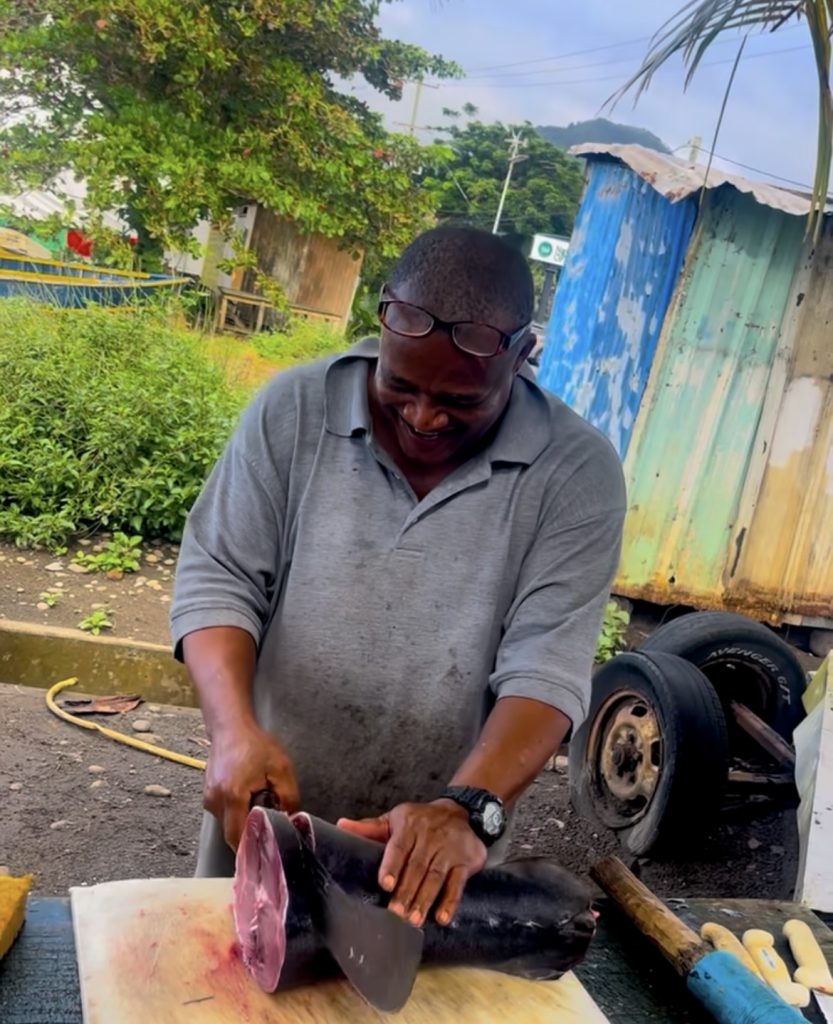
Encounters with locals can pop up anytime when visiting Dominica. Perhaps with a fishermen on the beach back from the day’s catch. Or meeting an historian who will tell you about the indigenous Kalinago people on the island (also known as Carib Indians). Or hanging with locals knocking back an ice cold beer at a roadside bar at the end of the day. That’s how you really get to know any place. And, if you are lucky, those encounters will drift through your dreams long after you return home (and be worth more than the 300 iPhone pictures you take).
But sometimes you have an unexpected encounter that tells a larger story of what happening on the island.
While driving through the countryside with my host, we stopped briefly at small Chinese run variety store. The young Chinese lady behind the counter was efficiently moving the cash transactions along when she began speaking Chinese with a Chinese man who was buying something. A Dominican woman standing behind me sharply called out, “Why don’t you speak English? You are in an English speaking country!”
The Chinese lady shot back, “I’ll speak Chinese if I want to!” A short verbal exchange ensued, not words of anger, but more a clash between strong personalities determined to stand their ground. The two Chinese appeared to be recent entrepreneurial immigrants in Dominica (not Chinese government officials).
Without reading too much into a single incident, the minor spat gave a glimpse into a shifting social dynamic on the island and the larger Caribbean.
The Chinese lady should be able to speak her native language without being scolded. Indeed, cultural and linguistic diversity should be welcomed as they enrich and enliven society. But the Dominican woman may have been expressing an underlying worry about “others” edging in without respecting the dominant culture and integrating. (That umbrage manifests itself in just about every society. We certainly see it in North America and Europe.) And the Chinese lady herself could be venting her own frustration of not being accepted because of who she was. Clearly, both should have been more sensitive to the other.
The unfortunate bellowing displayed by these two individuals contrast sharply with Caribbean island societies, including Dominica. West Indians are traditionally very inclusive and accepting of outsiders who immigrate and identify themselves as nationals of the island where they live.
Indeed, ethnically Chinese people (and every other nationality or ethnic group) who have lived in the Caribbean for generations see themselves as West Indian first, even if most of their social interactions are within the same ethnic group. This admirable trait has benefited Caribbean nations in the same way it has benefited the US (until this past year at least when immigrants were made to feel unwelcome).
In Dominica, however, the new Chinese immigrants have arrived at the same time the country is visibly experiencing the takeover of much of its infrastructure by the Chinese government. Some projects, like a new hospital or more schools, can be seen as gestures of goodwill. Indeed, why should an economically struggling island-nation say “no” to those–even if the not-so-subtle effort is to extend influence?
But the Chinese mega projects point to a far more disquieting agenda.
The giant new airport being bulldozed into the jungle (noted in the previous posting), along with the special seaport about to be carved into a cove on the wild east coast, stand out. They come with their own large foreign workforce that has no interest in integrating into the country. They are there solely to construct, maintain, and manage what amounts to an extension of China’s overseas power.
These mega projects are way too large for Dominica’s needs, and everyone knows it. As a result, an unease about the future has permeated social discourse, as China appears poised to exert sway over Dominica’s future and chip away at its sovereignty. So, it is not surprising that China’s growing clout can spawn resentments and lead to divisions within society.
The mega projects compel Dominica and other Caribbean countries with a strong Chinese presence to ask: What exactly is China’s objective and what will we owe for all this “development?” More specifically, is the enormous new airport and adjacent seaport also going to serve as a base to park Chinese planes, ships, drones, radars, and other military equipment? If so, the build up will certainly be seen as a provocation by the US (regardless of administration) and place Dominica in a tenuous position caught between two superpowers.
In view of the forceful extraction of Venezuelan president/dictator Nicolás Maduro last week, these questions take on a more ominous and urgent significance as a sense of foreboding sweeps over Caribbean islands.
In fact, the American incursion into Venezuela, together with the build-up of military force in the Caribbean writ-large, may push island nations like Dominica to make uncomfortable choices sooner rather than later. The stark options come with a huge risk of sharper fractures exacerbated by the spillover effect from Venezuela. Any decision could easily open the door to more internal conflicts within islands and risk further political instability.
While Trump’s confrontation with Maduro and now his removal from power may have slashed Chinese influence in Venezuela–especially access to oil–the strife may have enhanced the Chinese foray into Caribbean islands. A free gift from their arch adversary!
Rightly or wrongly, just about every Caribbean islander I have spoken with perceives the US actions in Venezuela as “bullying” and asks “Could we be next?”
Trump’s unilateral exercise of raw military power to take out Maduro with little pushback in the US seems to have overshadowed the brutal repression instigated by the Maduro regime.
That’s a sharp turn from the traditional close ties between the US and Caribbean islands over decades. Indeed, Caribbean island nations have long had strong connections and affinities with the US (notwithstanding periodic regime changing invasions since the late 1890s). Certainly far more than China, which is culturally and politically much different.
As those bonds with the US fray, the new boy on the block, China, will reap the benefits while also sowing its own divisive seeds. Chinese imperious and high-handed actions could well trigger a backlash on a national and personal level as played out at the variety store confrontation I witnessed last month. It gets complicated. But the US, a country that should be a natural ally and friend of the Caribbean, is losing out.
Bottom Line: Woefully misguided actions by the US and unconstrained Chinese power projections in the Caribbean can only heighten tensions and lead to confrontations that could easily spin out of control.
Leave a Reply