Don’t bet on it!
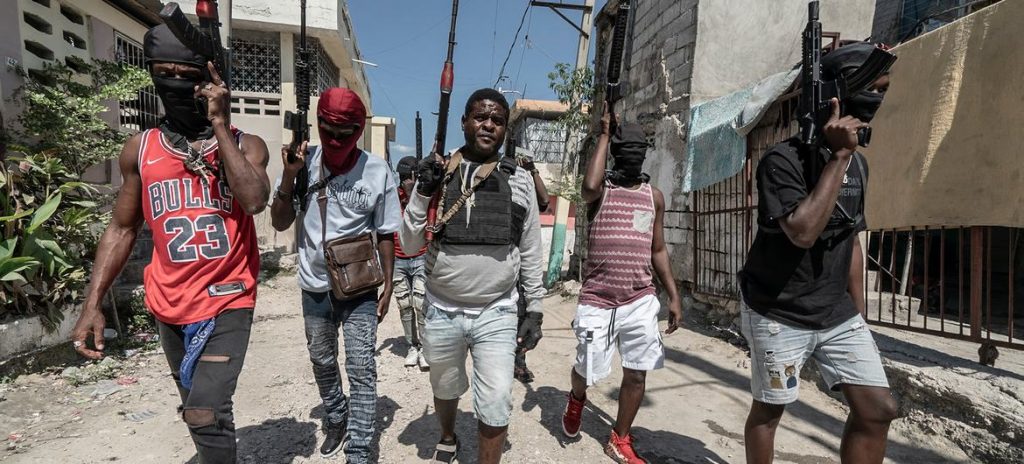
The US and the UN appear to be getting serious about taking on the gangs of Port-au-Prince that have controlled 80-90% of the city for the past four years. But the influx of foreign troops authorized by the UN/US, now called the “Gang Suppression Force,” is going about it all wrong with another “we know best” mindset.
Notably, the Gang Suppression Force, which understands little about Haiti, will be taking the lead instead of the Haitian National Police and the Armed Forces of Haiti (Forces Armées d’Haiti).
The US and other nations in Caribbean region are right to be concerned about threats posed by transnational criminal elements operating in Haiti in concert with gangs. More narcotics, guns, and people are being trafficked through and from Haiti. However, foreign interventions in Haiti to change the power balance seldom end well.
Let’s cut to the chase and see what’s going on.
US Navy and Coast Guard ships show Up–To what end?
In early February, US Navy guided missile destroyer, USS Stockdale, and two US Coast Guard cutters, USCGC Stone and USCGC Diligence, arrived in the Bay of Port-au-Prince. According to the Haitian Times, the US Embassy confirmed that the ships had been operating in Haitian waters. Actually, everyone in Haiti, as well as the Haitian Diaspora, already knew the ships were patrolling off the coast thanks to the wide dissemination of photos. All of which prompted speculation about what the US was up to–especially following the US combat mission that extracted Venezuelan dictator/president Nicolás Maduro from office a month earlier.
Note: The ability of ordinary people to obtain and quickly disseminate imagery of just about anything reflects a long-term trend in the leveling of intelligence collection. Government intelligence agencies no longer have a monopoly on intelligence. Ordinary citizens with limited resources, as well as gangs, can get in on the game.
US officials described the deployment of the ships to Haiti as a deterrence and support mission, not a direct military intervention in Haiti. They stated, “The presence reflects the United States’ unwavering commitment to Haiti’s security, stability and a brighter future.” Stirring words but devoid of meaning and swathed in cliché. It is not at all clear what the ships could or would do to stop gang authority and violence while anchored in the harbor.
Indeed, the failure of the US Embassy to explain the mission to Haitian people (and make the case for a buy-in) only reinforces skepticism about the US government’s true intentions. The attitude assumes that Haitian people don’t need to know because “we’ve got this, not you.” And that lack of engagement with the people directly impacted goes to the heart of the problem. Especially in this golden age of social media where everyone sees and comments on everything.
If nothing else, the American gunboats showing up in the Bay of Port-au-Prince reaffirms the recent amped up US military posture in the Caribbean region. So, it is fair to ask: Is there another agenda beyond the stated “brighter future” for Haiti? Apparently, the continued deployment of 11 US warships, 150 aircraft, and 2200 Marines in the Southern Caribbean is not enough to take on the transnational criminals they are supposedly there to counter.
Gang Suppression Force–Who’s in charge?
The UN (with US co-sponsorship) authorization to deploy a 5500 man Gang Suppression Force will greatly expand the current foreign troop presence of about 1200. The vast majority on the ground now are Kenyan soldiers but also includes Guatemalans, Salvadorans, Jamaicans, Bahamians, and Belizeans. The first contingent of the Gang Suppression Force is expected to arrive on April 1. And then what?
Will the additional numbers for foreign troops be enough to push the gangs out and make Port-au-Prince safe again? They might make some temporary gains. But, if the foreign forces take the lead and leave the Haitians as subordinate, the gains will be temporary and failure assured.
Why is Haitian lead important? Because the perception of foreigners calling the shots waters down the legitimacy of the mission, especially when suspicions about ultimate aims run high. It displays an arrogance and disempowers the locals. Indeed, gang leaders have often sought to legitimize their role by casting themselves as “freedom fighters” who represent the people against foreign injustice. Foreigner troops blasting away in an effort to kill gang members–that inevitably kills civilians–helps to fuel that perception.
Austin Holmes, a Florida entrepreneur with extensive humanitarian and crisis management expertise in Haiti, testified before a Senate Appropriations Subcommittee hearing on Haiti’s security on February 12, 2026. In his testimony he argued for significantly greater investment in Haiti’s security apparatus and stated, “I think what’s important here for all of us is that Haitians are seen leading their security initiative.” Mr. Holmes has it right.
Unfortunately, the Gang Suppression Force seems intent on taking charge in fighting the gangs–even if foreigner leaders may claim to work as partners with Haitians. But the focus needs to be about Haitians fighting for Haitians. That’s what gives them credibility and support from the people–the essential factor for winning wars today. The Haitians have been in this fight for years and built up the expertise to understand the situation far better than the foreigners.
Here’s how to make it work
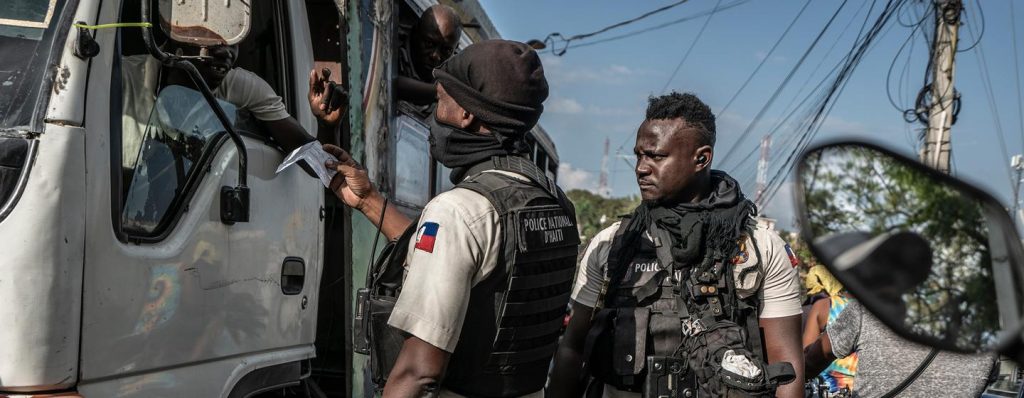
Establish a “Combined Command” structure that puts Haitians in charge while leveraging the capabilities of the Gang Suppression Force. This way foreign military officers can jointly engage alongside Haitian National Police and Armed Forces officers to receive, analyze, and act on the same intelligence. Indeed, it is essential that everyone involved works from the same playbook. A Combined Command ensures that goal.
Of course, everything is complicated in Haiti, including charges of police corruption undermining effectiveness. But such charges must not distract from the courage shown by the vast majority of Haitian National Police officers, as well as Armed Forces, who risk their lives to confront the gangs every day. A Combined Command structure can serve to remedy concerns about corruption as well as enhance legitimacy because Haitian and foreign units will share a common operating picture. This includes creating accountability and shared ownership of outcomes.
At the same time, foreign governments need to commit to building up the numbers of the Haitian National Police and Armed Forces along with training and equipment. Henry Wooster, the Chargé D’affaires at the US Embassy in Port-au-Prince also testified before the Senate Appropriations Subcommittee hearing on Haiti security. As reported in the Miami Herald, he said that while 12,000 armed people account for gang membership, about 3,000 “pose the greatest threat.” He added, “By contrast, the Haiti National Police has approximately 6,000 personnel on the books, of whom 400 or less do most of the fighting.” Clearly, a vast imbalance that must be corrected if there is to be any progress.
Also complicating matters are the wealthy Haitian elites who often support the gangs for their own gain. Their involvement and benefit must be identified and cut to take down the gangs.
Moreover, Haiti’s Transitional Presidential Council, the temporary government authority, lost its mandate to rule on February 7, 2026. That has left the country in a political vacuum, and no time-frame for elections has been set. Dire as this is, efforts to take down gangs cannot be suspended due to a barely functioning government.
Working through a Combined Command with additional manpower, the Haitian National Police and Armed Forces will have the best and perhaps only chance to crack the control of the gangs, open blocked corridors to the city, and liberate the people living in fear. This would allow the desperately needed aid to flow back, markets and clinics to reopen, and make Haiti safe enough to hold elections.
Kick out the mercenaries–They do more harm
Further aggravating the knotty mix of foreign and local forces in Port-au-Prince are some 200 mercenaries who have been on the ground since August 2025. They are mostly employed by Vectus Global, a private security company owned by American Erik Prince. That is the same Erik Prince who founded (and rebranded) the notorious security company Blackwater Worldwide, whose security team massacred 17 civilians in Iraq in 2007. As pointed out in an earlier post on this site, Vectus Global’s contract with the Haitian government for security services likely runs into the tens of millions of dollars.
Vectus Global’s mercenary services includes using “Kamikaze” drones to find and blow up gang leaders. But the drones–a cutting-edge weapon–have wreaked more havoc than produced meaningful results. Despite multiple efforts by police and mercenaries to take out Jimmy Chérizier (aka BBQ, leader of the gang alliance Viv Ansanm) by drones, he remains in power.
At the same Senate Appropriations Subcommittee hearing, Senator Chris Murphy (D-CT) stated that reports indicate that “an American company operating drone strikes inside of Haiti has killed 559 people and 11 children.” Indeed, Senator Murphy’s facts underscore the need to avoid civilian casualties, particularly as foreign forces increase. That also includes mitigating casualties among the many boys who are often pressured or forced to be lookouts or fight for the gangs, as human rights groups have pointed out.
Vectus Global’s contract needs to be terminated since their presence and sometimes heavy-handed actions only sustain the perception that foreigners do more harm than good.
Bottom Line
Give the Haitian National Police and Armed Forces the training and tools to lead the fight against the gangs with support from the Gang Suppression Force, not the other way around. And get rid of reckless mercenaries whose only goal is to get paid regardless of the consequences. Haiti still has a chance to crush the gangs controlling Port-au-Prince. Foreign forces can help achieve that goal–but only if they do it right.
Next post will outline a strategy to take back gang territory one neighborhood at a time.
Leave a Reply