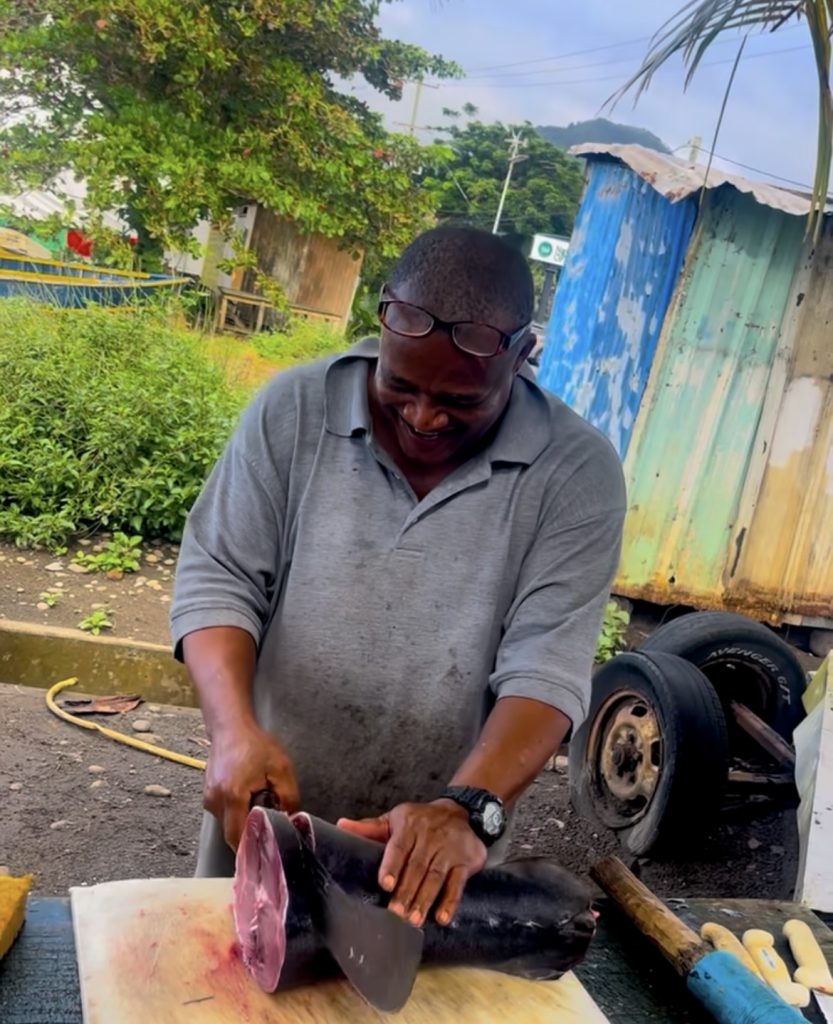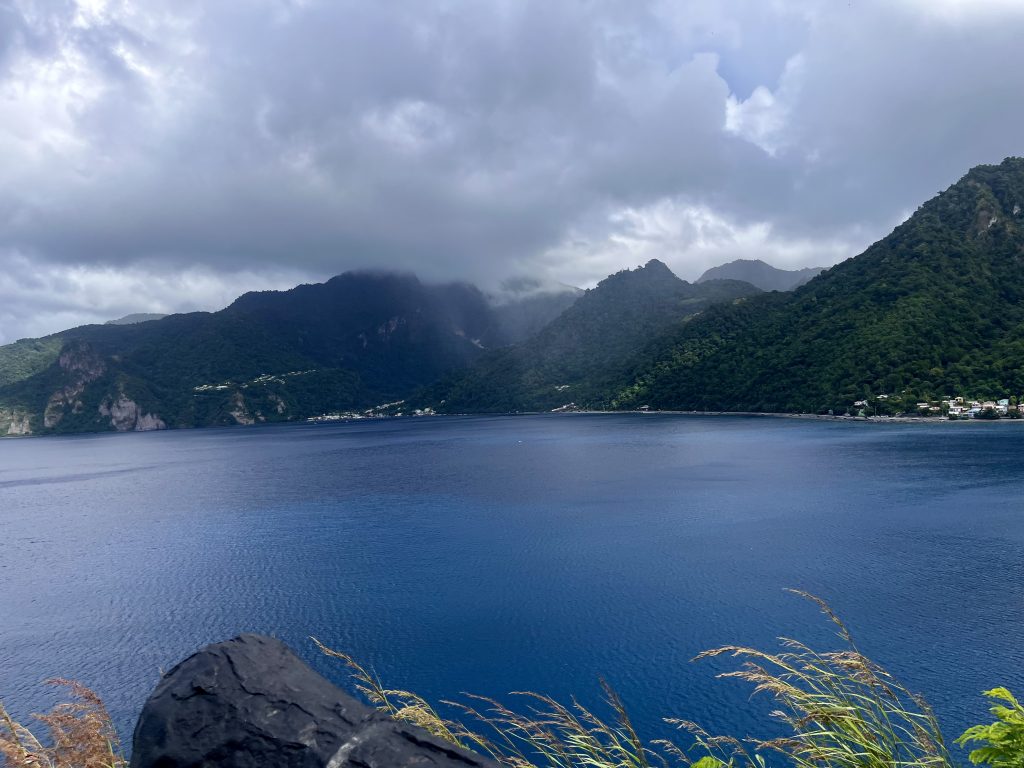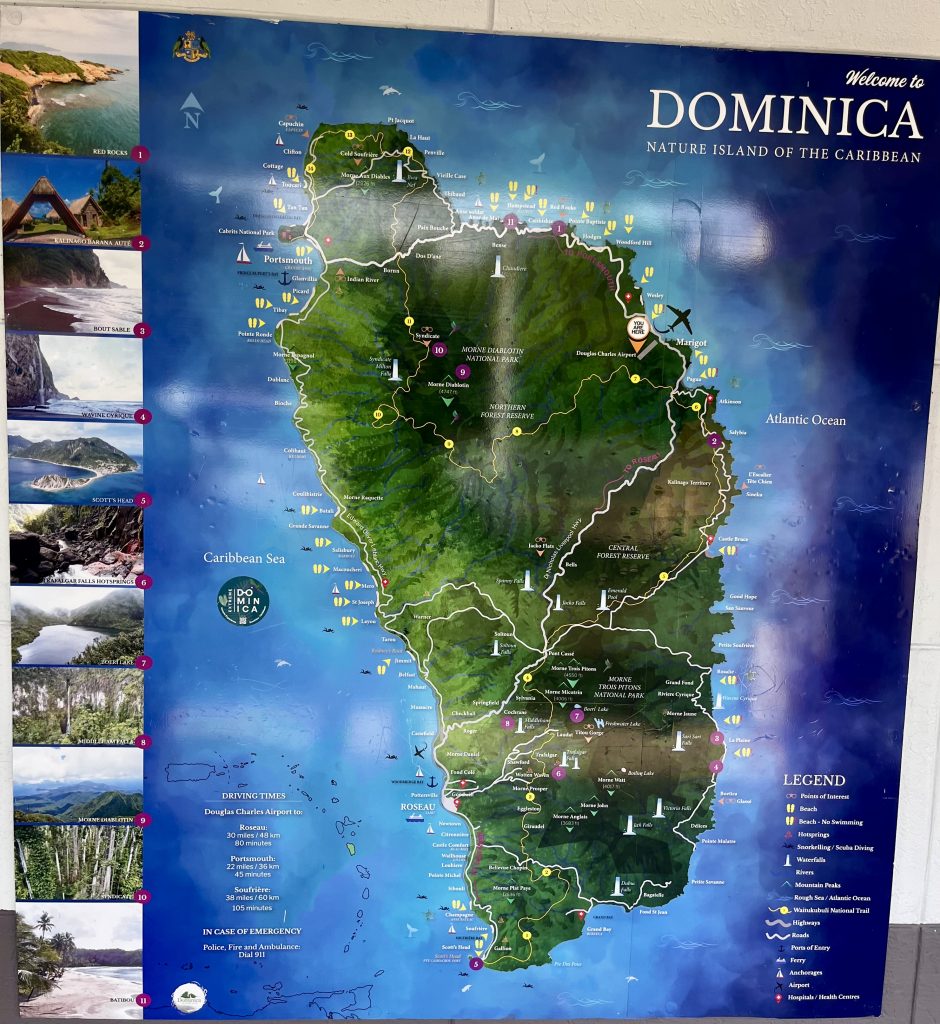
I just came back from a trip to Dominica last week visiting an old friend there. When I lived in the US Virgin Islands, I used to fly into Melville Hall Airport on the northeast coast–always a hairy landing skimming the tops of coconut trees on approach. Glad to say that the airport has been significantly upgraded and now welcomes commercial airline jets from the US. But even though it’s much easier to get to Dominica these days and the island is “on the map,” the place remains a world apart–mind-blowing wild beauty that, except for a few small towns, not much different than what Columbus saw when he sailed by in 1493.
I stayed in Dos D’Ane village surrounded by high mountains of green jungle between the airport and the town of Portsmouth on the west coast. The name means “back of the donkey.” Not sure why the village is called that, but it’s about as tranquil as it gets. To get there or anywhere in Dominica, prep yourself for some serious switchback mountain roads that somehow everyone there knows how to navigate. (Luckily, I wasn’t driving.) The roads are mostly pretty well-paved, though not very wide. But what really catches the eye is the extensive beautification along the roads all over the country. I mean gorgeous plants lining the streets and not one bit of litter. The people and government are totally committed to retaining the ecological wonderland that it is.
Food, as you might imagine, grows everywhere in the rich soil. People who have more than they need from the garden give it away. No one goes hungry in Dominica. Some houses are ramshackle but most are modest structures and well-maintained. A few high-end fancy resorts appear here and there but they are small.
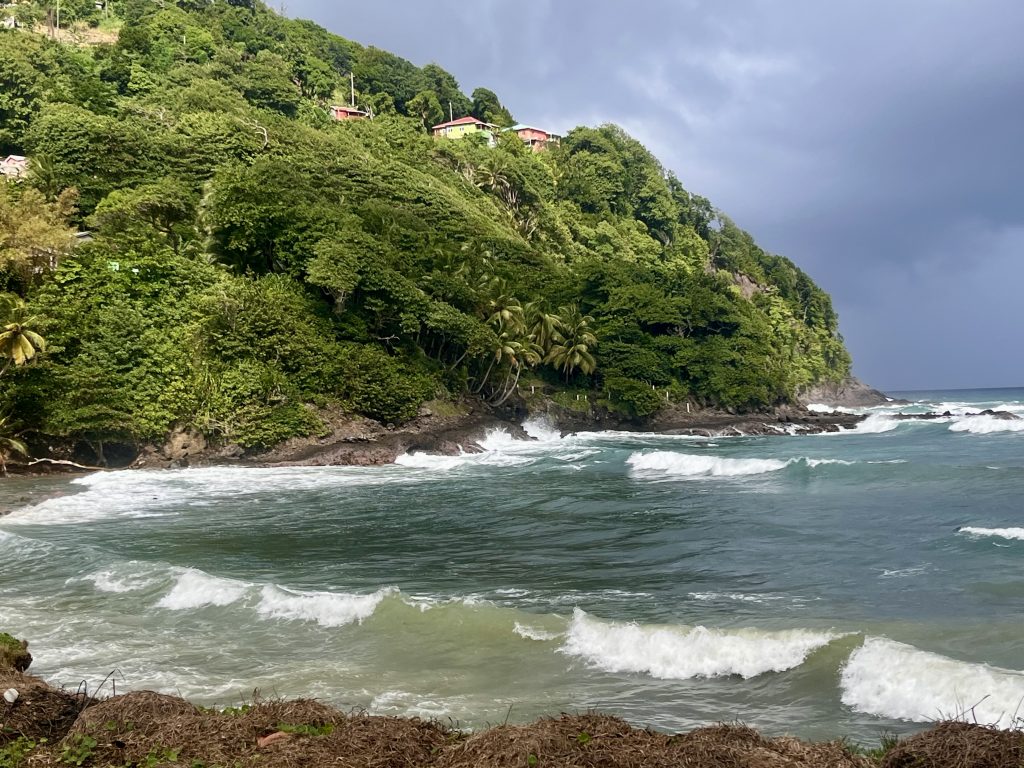
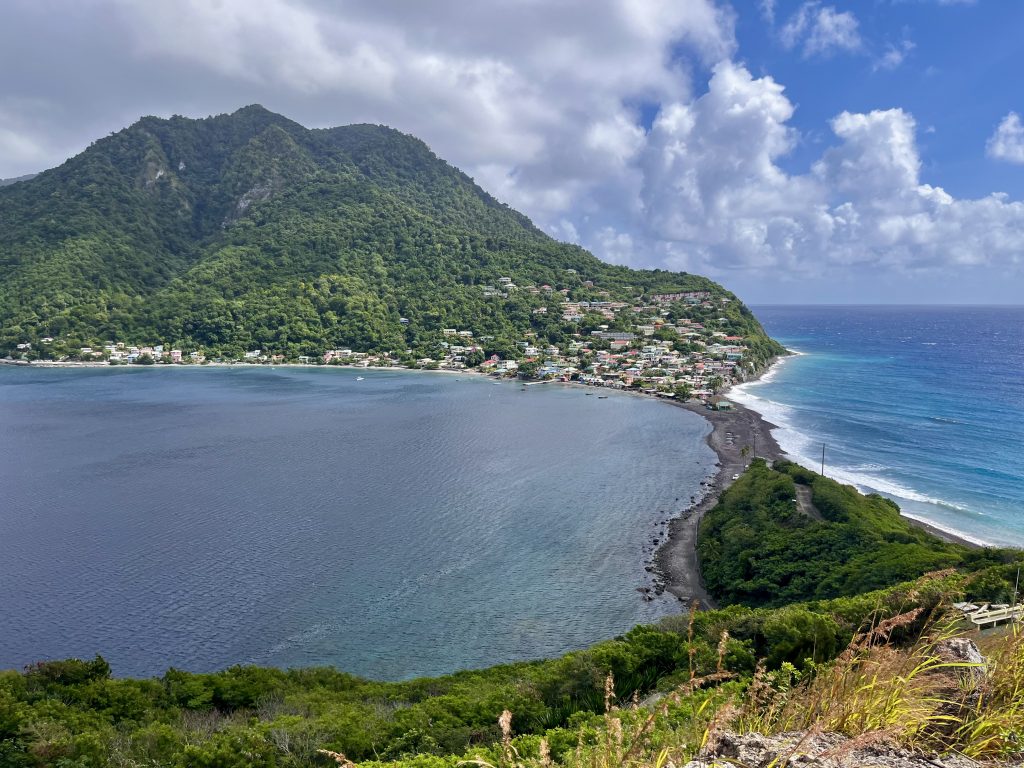
Beaches? Mainly rocks and grey or black sand. This is a volcanic island after all. While the beaches don’t invite much swimming like the Turks & Caicos, they still mesmerize the senses. Along with the jagged coast of jungle with mist sweeping down from the high peaks. And the waterfalls, rivers, and small lakes, cold and hot. In Dominica, a sense of adventure greets you at every turn as do the wonderfully friendly people. Everyone is genuine and helpful. And if you meet tourists visiting from anywhere, you will surely share a spirit of being in a magical place.
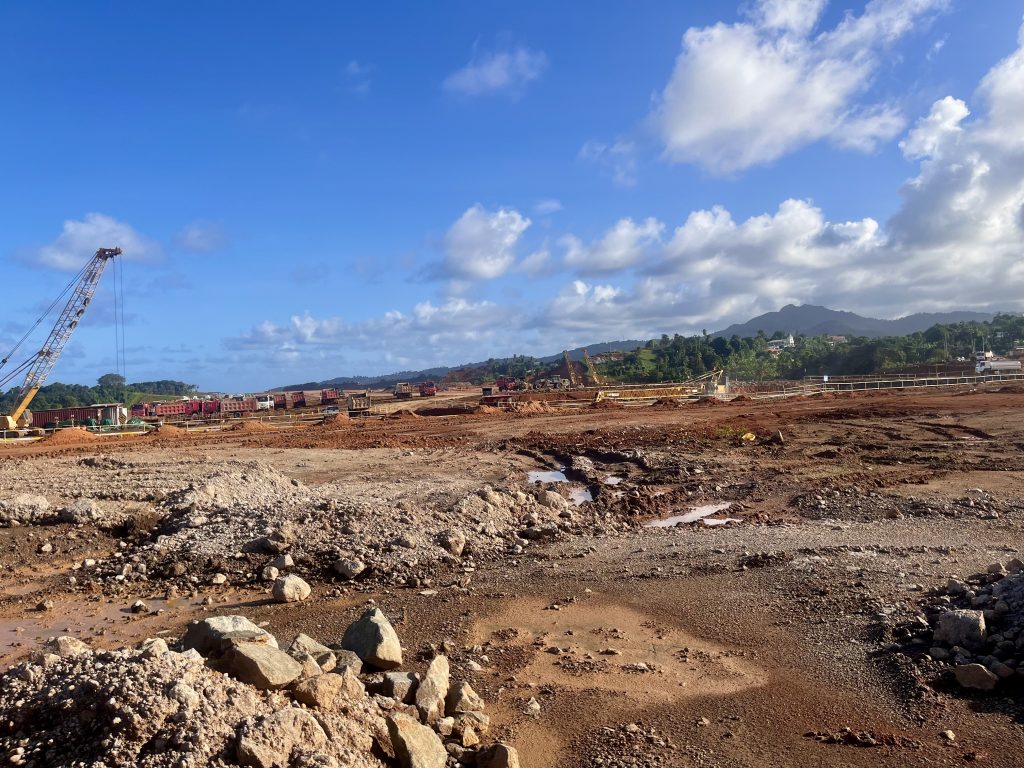
Being the political junkie that I am, I took close look at the ubiquitous Chinese government presence on Dominica. Projects everywhere! Hospitals, schools, and friendship centers all with signs in English letters and Chinese characters. The biggest project of all is a massive airport under construction just a couple of miles north of the current airport. Huge trucks carrying rock and dirt run 24 hours a day, I’m told. Cranes and bulldozers clear away giant swaths of jungle. But a brand new airport clearly is not needed since the current one with its small terminal handles all the flights just fine.
Now plans are afoot to build a giant port right next to the new airport, ostensibly to bring in all the construction material so the Chinese don’t have to truck it across the island from the capital Roseau. OK, but a whole new port just to support the airport? All of which begs the question, what’s really going on?
Actually, Chinese presence all over the Caribbean is growing with no end in sight. Why? Influence, UN votes, radar stations, maybe even bases are likely all on the agenda in view of proximity to the US. I should add that Trump’s saber rattling over Venezuela and recent ban on granting travel visas to Dominicans has turned many here against the US government. An that has no doubt made the Chinese presence easier to accept. Troubling since US and Dominica have always been natural allies along with the rest of the Caribbean islands. But that tradition is fast disappearing as the Chinese pour in economic development while the US shows off with a fleet of big gunboats. Watch this space for updates.
What could possibly go wrong in the Southern Caribbean?
The day of reckoning for Venezuela and the United States fast approaching! $40 billion in military assets and 15,000 sailors and Marines deployed to the Southern Caribbean appears not to have persuaded Venezuelan president/dictator Nicolás Maduro to step down. Nor has the blowing up of skiffs purportedly carrying narcotics somewhere (though not to the US). Nor have sanctions or the seizure of an oil tanker loaded with Venezuelan crude. Threats of airstrikes and even putting US troops “on land” have done nothing either to move the needle on regime change.
So how will this madness play out? The parallels to the run-up to the Iraq War reverberate almost a quarter century later. Here’s my take as a former DoD threat analyst.
Start with the premise that Trump has invested too much in this vanity adventure to just order the fleet to return home with nothing to show. In a still hazy foreign policy, Maduro would be forced out and somehow Venezuela’s democratic leaders would emerge from hiding and take the mantle of power while riding on a wave of simmering anti-Maduro sentiment.
American actions did appear to embolden the underground pro-democracy elements. They see a US pressure or even a direct intervention as their only chance to regain power in Venezuela. Last week Nobel Peace Prize winner Maria Corina Machado took a dangerous risk (along with others) to escape the country by boat to the island of Curaçao to the north. From there she traveled to Oslo to meet with the Nobel Peace Prize Committee that granted her the prize (accepted earlier by her daughter). Her Nobel Peace Prize and now freedom outside of Venezuela gives her a much larger platform to advocate for regime change and restoration of democracy with American help.
But there is no pro-democracy guerrilla movement in mountains to oppose the Venezuelan military. In fact, there is no organized group of freedom fighters with firepower that US could theoretically support clandestinely or openly. And despite all the bluster of troops “on land,” a couple of thousand Marines on the aircraft carrier Gerald R. Ford won’t be able to topple an entrenched Maduro with heavy support from his generals and admirals. In fact, even a coup is unlikely from these top military leaders.
It is worth examining why the generals and admirals are so loyal to Maduro. There are at least 2000 generals and admirals in the Venezuelan army. Probably more. That top-heavy number comes to a ratio of about 1 general/flag officer to 75 soldiers or sailors in a military force of 150,000.
By comparison, the US has about 1 general/flag officer to 1400 soldiers or sailors commanding a force of 1.3 million. (And even that is a bit top-heavy due to “rank-creep.”) Why the disproportionate ratio in Venezuela? Because Maduro has cleverly promoted these men to prestigious and powerful command positions to ensure more loyalty. Most of them are directly involved in and profiting off of major businesses in Venezuela. In other words, serious corruption and therefore a strong motivation to maintain the status quo. Oppose Maduro, and you will lose your lucrative criminal enterprise and probably your life.
The Venezuelan army also loosely controls a slew of pro-Maduro para-military groups known as Colectivos. Should the democratic opposition come out of hiding, the Colectivos, little more than gangs, could be counted on to viciously suppress them even though a majority of Venezuelans support a return to democracy.
In view of the human rights abuses by the Venezuelan government, the worst in the Americas, pressuring Maduro to step down is not wrong. Just like toppling Saddam Hussein was not morally wrong.
The problem lies in the dubious rationales and reckless implementation that inevitably lead to massive cost in blood and treasure.
US hubris and search for quick solutions tend to set in motion unintended consequences that make things far worse. Regime change in Venezuela would be even harder than Iraq and lock the US into another forever-war and nation-building trying to fix the broken pieces. But that has not slowed down the Trump administration’s obsession with of replacing the current government with a more pro-American one.
It appears that the US is in the advanced “mission creep” stage where strikes on skiffs and tanker seizures are just not producing the results desired. That’s when military leaders typically call for more resources and wider latitude to neutralize the enemy or at least show tangible gains. In this case, the call may be for more combat ready troops to land and hold ground somewhere in Venezuela. But more resources to escalate the fight will not alleviate the Trump administration of its no-win position.
On the one hand, the large US presence and actions in the Southern Caribbean compels action to save face and show that Americans don’t back down to anti-American tinhorn dictators . On the other hand, the uncertainty of success and risk of catastrophic failure demands restraint.
The US would have a hard time controlling the country even if they threw in 50,000 troops with massive logistical backing. Still, Trump might wake up in the middle of the night in a moment of insanity and decide to invade on a whim because “national security” (and his ego) demands it. Or maybe he will need a distraction from a particularly bad news cycle. Though less likely than other scenarios, we cannot rule out him setting in motion a cascading disaster that would tear both Venezuela and the US apart. One can only hope that American general/flag officers would step in and say “No!” even if it meant the end of their careers.
The only viable options open to Trump at this point are to bomb Maduro out of power or negotiate with him.
Let’s look at the first option. If Maduro is killed, captured, or flees into exile, senior commanders would take over and rule by decree. Trump would have to negotiate with them. They might talk, but nothing would really change because they aren’t going to give up power or corrupt influence that generates wealth.
Now, there is a chance that without Maduro, the cohesive figure holding the generals together, might fray. In that case, we could see them fight each other over turf that would ultimately lead to a military version of gang warfare across the country. And that would almost certainly trigger a massive humanitarian crisis with millions more fleeing the country, along with the specter of famine and disease streaming in realtime for the world to watch. Oil production would come to a near halt. A bloody lawlessness would prevail even if some general managed to carve out enough control to claim authority to govern the country.
In this possible scenario, the transnational criminal gangs have the most to gain as they could set up hubs to ratchet up narcotics operations in South America and Caribbean islands, which until now have been minor. These gangs, working with generals and remnants of the Colectivos, would be in a position to ship far more drugs into the US. The irony is not lost.
The second option of Trump and Maduro negotiating may be more likely. Maduro knows he holds some high cards because of the extreme challenges of an American invasion, and that the clock is ticking in his favor. The US can’t linger off the coast of Venezuela forever. Maduro is quite aware that Trump is anxious for an out where he can show some kind of win that can be spun and sold to his base.
That’s when Maduro might throw a bone and agree to reduce shipments of oil to China and Cuba and sell more to the US. He could promise to clamp down on drug trafficking (the ostensible reason for US presence in the Southern Caribbean). And Maduro could toss in a contract for a big American oil company. (Trump likes business deals, especially if he or his family or cronies can benefit.) It would take a lot of spin, but Trump could declare victory of sorts and order the ships to sail away while threatening to return if Venezuela does not comply. And Maduro could hang on to power and continue to rule with an iron fist.
Meanwhile, while this limited US incursion plays out, things can still veer wildly out of control and wreak havoc.
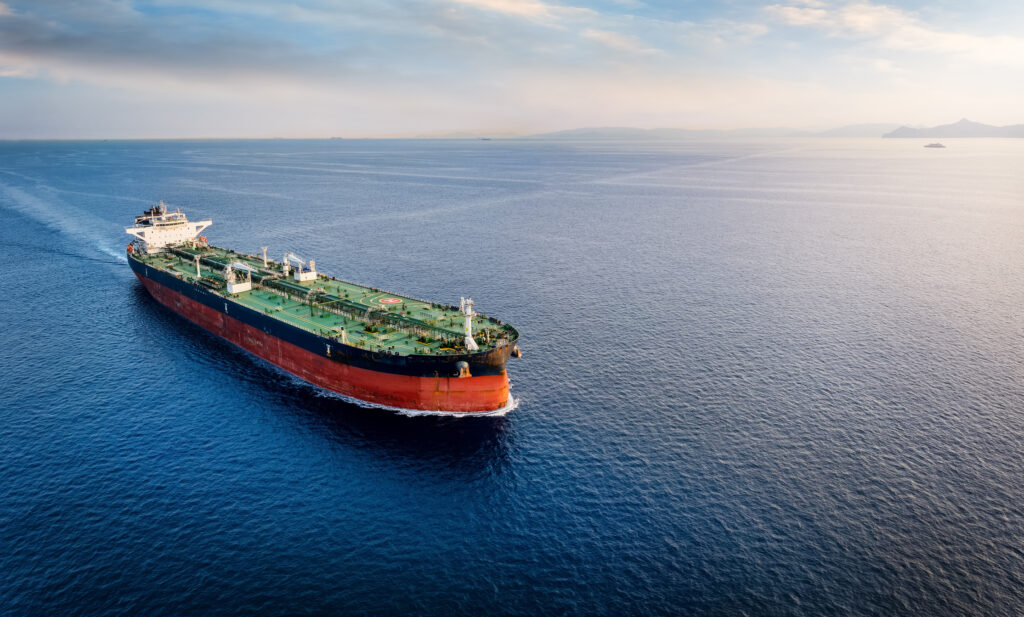
For example, the US ship-boarding team that seized the oil tanker “Skipper” last week puts the ship at greater risk of running aground or exploding if they don’t ensure that crews properly monitor operations. According to a tanker expert, this means maintaining the inert gas system to maintain a non-explosive atmosphere in the cargo tanks. That’s in addition to keeping the main engines and generators operational. If these fail, the ship is immediately in peril of an accident. This “vintage” (20+ years old) ship sailing under a false flag (Guyana) with an unknown call sign that may not have met scheduled maintenance inspections hardly inspires confidence.
But once the US team takes command of the ship, they are responsible, even if the capabilities of the crew and the ship itself are below standard. Complicating the matter further, a heavily laden very large crude carrier (VLCC) such as the “Skipper” differs significantly from US Navy or Coast Guard vessels. Therefore, a Navy or Coast Guard officer of the deck (OOD) placed in command of a VLCC will not know how to safely operate it unless he or she has had merchant marine training and experience.
Hopefully, the US has planned ahead for a seizure of one of the world’s largest crude tankers and can quickly insert the necessary nautical expertise. But so far, all we have seen is dramatic video of a special operations team repelling on to the deck from a helicopter and taking over. Now what?
It’s not hard to imagine a nightmare accident that spills a couple of million barrels of crude oil into the Caribbean Sea that sloshes on to island beaches. Such a disaster would kill off tourism revenue and sink island economies. The clean-up and compensation costs to the US would be enormous. And the resentment sure to be stoked could turn some island-nations away from the US and induce them to cast their lot with US adversaries—setting in motion a whole new set of consequences for the region.
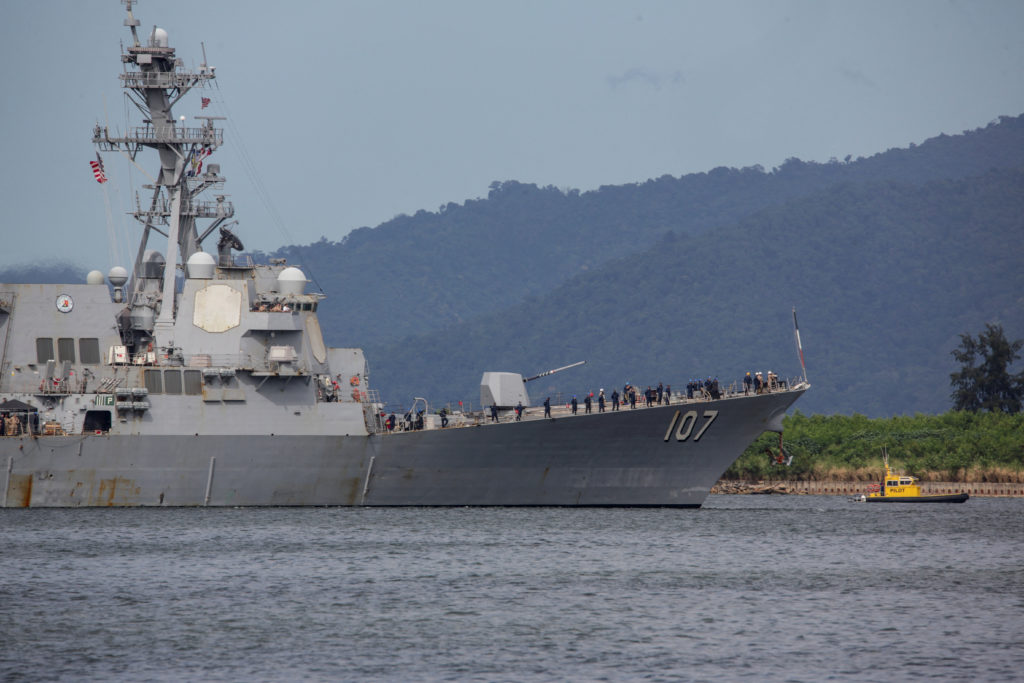
The U.S. Navy destroyer USS Gravely (DDG-107) approaches Port of Spain, Trinidad
As the US military saber rattling escalates against Venezuela, including closing the country’s airspace, the US is pushing Caribbean island-nations for greater security cooperation. Notably, US Department of Defense officials have been holding high level talks with Trinidad & Tobago and the Dominican Republic to provide access to military bases, ports and airports.
The American pitch is framed as a larger partnership strategy to counter narcotics trafficking through the Caribbean. But these anti-drug trafficking overtures cannot be separated from the prospect of forcing regime change in Venezuela. All of which is looking more like a grandiose US geopolitical game plan for the region with hazy the objectives.
It is plausible that drug traffickers might be changing their modus operandi by applying high tech methods to better conceal their boats and using different routes to reach the US. And this should compel a more aggressive US response. However, details of a more sophisticated drug trafficking threat have not been presented or openly discussed. If drug traffickers really are shifting their tactics and upping their game, then why is the response confined to blowing up open skiffs powered by outboard motors off the coast of Venezuela (along with boats off Central America on the Pacific side) ?
Are these skiffs just easy pickings to allow some visible “wins” (or cheap thrills) for the flotilla gathered in the Southern Caribbean? If so, it begs the question: Why can’t the biggest and most lethal armed force the world locate and intercept the dangerous boats supposedly sneaking their way north up the chain of islands? The capture of just one high-tech boat with crew intact (not stupidly blowing it up and killing everyone) could go a long way to show the serious threat of drug trafficking across Caribbean waters. And certainly more believable than blasting away small boats off the Venezuelan coast alleged to be carrying drugs but never proven.
Without more evidence of drug trafficking from boats, high-tech or otherwise, the over-arching justification for massive American military presence smacks of the “weapons of mass destruction” claim that propelled the US into Iraq almost a quarter century ago. The current US claims may well cause some island-nation leaders to wonder just what they are being asked to sign up for and the price. And what is the bigger American agenda?
Now, an expanded American engagement with the Caribbean could be a good thing and become a force-multiplier. Not just to help counter drug trafficking but also gun smuggling, human trafficking, and transnational crime generally throughout the region. American initiatives could also pave the way for more cooperation to beef up Caribbean armed forces to combat gangs, particularly in Haiti, but also on other islands. Enhanced collaboration could also be combined with investment incentives, trade barrier reductions, and disease eradication programs to further strengthen institutions and goodwill. A robust and symbiotic American presence comes with the added bonus of keeping adversaries like China, Russia and China at bay.
Instead, the current proposed partnership appears to be limited to using Caribbean islands for expanded American military presence. That raises suspicions among Caribbean people and their leaders, as they are all too familiar with American troops occupying island-nations and dictating terms since the early 1900s. Moreover, it invokes the long legacy of colonial rule that resides deep in the Caribbean heart.
Current negotiations with Caribbean governments might be limited to conducting US operations in national air space and territorial waters, as well as parking spots for planes, ships, and radars. Intelligence sharing is also likely part of the package. But all that will raise concerns about sovereignty and strings attached. It’s a delicate balancing act for the island-nations that lends itself to pragmatism. But greater confidence and assertiveness among Caribbean countries and a wariness about the costs vs benefits could temper US ambitions. If there is going to be amped up cooperation, Caribbean island-nations will want to bargain as equals, not junior associates.
Indeed, questions about American intentions regarding regional engagement may have become more concerning by the troubling revelations in the Washington Post on Nov 28, 2025. The article states that after the first skiff off Venezuela was hit with eleven people on board in September, two people miraculously survived. It is unclear whether Secretary of Defense Pete Hegseth, who was watching the first strike, gave the order to kill two survivors clinging to the smoldering wreck or if he just said “kill the all.” Regardless, Admiral Frank “Mitch” Bradley, Special Operations Command, gave the direct order to blow up the last two survivors as well. Unreleased video of the survivors purportedly shows them desperately clinging to debris and trying to overturn the severely damaged boat for 41 minutes.
There is no justification for killing people on a boat, even a suspected drug boat, that does not pose a threat. Killing survivors struggling in the water is even more heinous and clearly a war-crime by any US or international legal standard (spelled out in the Geneva Convention) and possibly murder. That heinous act, if proven true, thus presents another dilemma for Caribbean leaders: Do they want to align themselves with a US leadership that so callously disregards human life> Especially when the only ones killed are on the lowest rung on the drug trafficking ladder, the desperate ones trying to make a few hundred dollars for driving a boat?
The Trump administration’s bellicosity and lawlessness today may well cause some Caribbean countries to back away from American cooperation, even with the US dangling partnership enticements. That erosion of trust and unravelling of American goodwill could turn parts of the Caribbean against the US and leave the region more fractured, impoverished, and unstable.
On a personal note, as a longtime Caribbean observer and resident, it deeply pains me to see my country spiraling downward and erasing the qualities that once defined it as a force for good in the world, however imperfect. That said, I am confident that Trump’s pigheaded and toxic approach to the Caribbean, and just about everything else this administration touches, will change. Stay tuned for a post-Trump era for the region could look like.