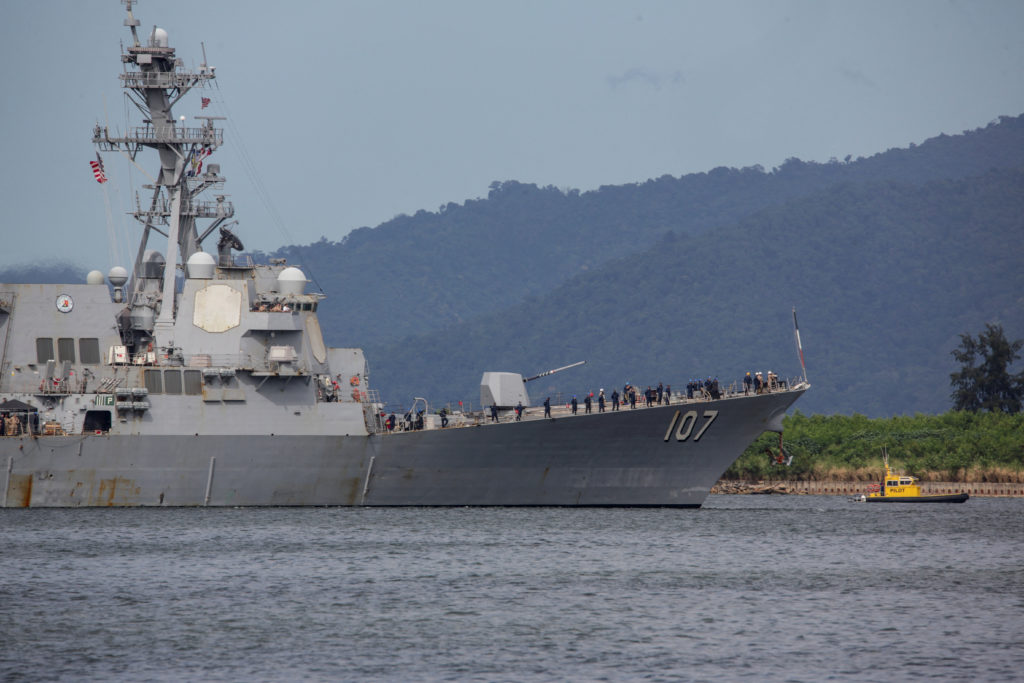
As the US military saber rattling escalates against Venezuela, including closing the country’s airspace, the US is pushing Caribbean island-nations for greater security cooperation. Notably, US Department of Defense officials have been holding high level talks with Trinidad & Tobago and the Dominican Republic to provide access to military bases, ports and airports.
The American pitch is framed as a larger partnership strategy to counter narcotics trafficking through the Caribbean. But these anti-drug trafficking overtures cannot be separated from the prospect of forcing regime change in Venezuela. All of which is looking more like a grandiose US geopolitical game plan for the region with hazy the objectives.
It is plausible that drug traffickers might be changing their modus operandi by applying high tech methods to better conceal their boats and using different routes to reach the US. And this should compel a more aggressive US response. However, details of a more sophisticated drug trafficking threat have not been presented or openly discussed. If drug traffickers really are shifting their tactics and upping their game, then why is the response confined to blowing up open skiffs powered by outboard motors off the coast of Venezuela (along with boats off Central America on the Pacific side) ?
Are these skiffs just easy pickings to allow some visible “wins” (or cheap thrills) for the flotilla gathered in the Southern Caribbean? If so, it begs the question: Why can’t the biggest and most lethal armed force the world locate and intercept the dangerous boats supposedly sneaking their way north up the chain of islands? The capture of just one high-tech boat with crew intact (not stupidly blowing it up and killing everyone) could go a long way to show the serious threat of drug trafficking across Caribbean waters. And certainly more believable than blasting away small boats off the Venezuelan coast alleged to be carrying drugs but never proven.
Without more evidence of drug trafficking from boats, high-tech or otherwise, the over-arching justification for massive American military presence smacks of the “weapons of mass destruction” claim that propelled the US into Iraq almost a quarter century ago. The current US claims may well cause some island-nation leaders to wonder just what they are being asked to sign up for and the price. And what is the bigger American agenda?
Now, an expanded American engagement with the Caribbean could be a good thing and become a force-multiplier. Not just to help counter drug trafficking but also gun smuggling, human trafficking, and transnational crime generally throughout the region. American initiatives could also pave the way for more cooperation to beef up Caribbean armed forces to combat gangs, particularly in Haiti, but also on other islands. Enhanced collaboration could also be combined with investment incentives, trade barrier reductions, and disease eradication programs to further strengthen institutions and goodwill. A robust and symbiotic American presence comes with the added bonus of keeping adversaries like China, Russia and China at bay.
Instead, the current proposed partnership appears to be limited to using Caribbean islands for expanded American military presence. That raises suspicions among Caribbean people and their leaders, as they are all too familiar with American troops occupying island-nations and dictating terms since the early 1900s. Moreover, it invokes the long legacy of colonial rule that resides deep in the Caribbean heart.
Current negotiations with Caribbean governments might be limited to conducting US operations in national air space and territorial waters, as well as parking spots for planes, ships, and radars. Intelligence sharing is also likely part of the package. But all that will raise concerns about sovereignty and strings attached. It’s a delicate balancing act for the island-nations that lends itself to pragmatism. But greater confidence and assertiveness among Caribbean countries and a wariness about the costs vs benefits could temper US ambitions. If there is going to be amped up cooperation, Caribbean island-nations will want to bargain as equals, not junior associates.
Indeed, questions about American intentions regarding regional engagement may have become more concerning by the troubling revelations in the Washington Post on Nov 28, 2025. The article states that after the first skiff off Venezuela was hit with eleven people on board in September, two people miraculously survived. It is unclear whether Secretary of Defense Pete Hegseth, who was watching the first strike, gave the order to kill two survivors clinging to the smoldering wreck or if he just said “kill the all.” Regardless, Admiral Frank “Mitch” Bradley, Special Operations Command, gave the direct order to blow up the last two survivors as well. Unreleased video of the survivors purportedly shows them desperately clinging to debris and trying to overturn the severely damaged boat for 41 minutes.
There is no justification for killing people on a boat, even a suspected drug boat, that does not pose a threat. Killing survivors struggling in the water is even more heinous and clearly a war-crime by any US or international legal standard (spelled out in the Geneva Convention) and possibly murder. That heinous act, if proven true, thus presents another dilemma for Caribbean leaders: Do they want to align themselves with a US leadership that so callously disregards human life> Especially when the only ones killed are on the lowest rung on the drug trafficking ladder, the desperate ones trying to make a few hundred dollars for driving a boat?
The Trump administration’s bellicosity and lawlessness today may well cause some Caribbean countries to back away from American cooperation, even with the US dangling partnership enticements. That erosion of trust and unravelling of American goodwill could turn parts of the Caribbean against the US and leave the region more fractured, impoverished, and unstable.
On a personal note, as a longtime Caribbean observer and resident, it deeply pains me to see my country spiraling downward and erasing the qualities that once defined it as a force for good in the world, however imperfect. That said, I am confident that Trump’s pigheaded and toxic approach to the Caribbean, and just about everything else this administration touches, will change. Stay tuned for a post-Trump era for the region could look like.