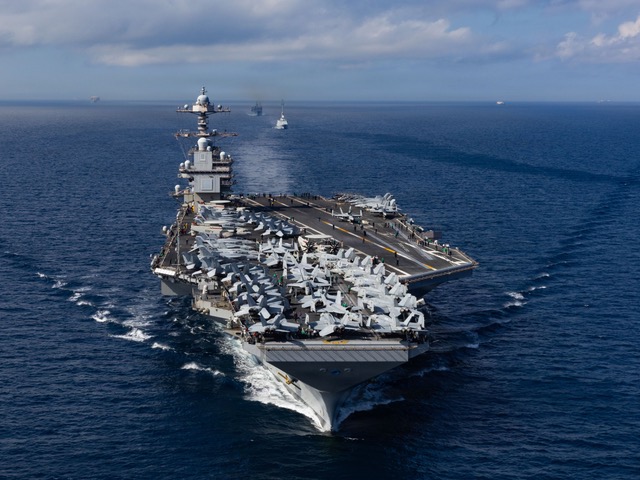
USS Gerald R. Ford
Time to draw upon my years in Department of Defense and weigh in on the massive US military buildup in the Caribbean and potential conflict with Venezuela.
First, let’s dispense with the “stopping the flow of drugs into the US” the “narcoterrorism” labels as justification. The drug flow from Venezuela into the US is relatively minimal compared to Mexico and Colombia. And blowing up small skiffs that may or may not have drugs and killing everyone smacks of extra-judicial killings and likely a warcrime. And that in turn puts US military personnel in grim quandary about what exactly they should or should not be doing.
Moreover, drone attacks that kill those on board is plain stupid and counterproductive. That’s because those on board could have been taken into custody and interrogated. From them the US could learn the modus operandi, production locations, transport hubs, and drug lords directing the enterprise. It’s called basic intelligence collection and could yield a great deal of information that would actually matter in the war on drugs–if that was the aim. And, by the way, the drugs could be seized and shown off to the world as evidence. But none of that is happening.
So what else is going on? Tragically, it’s more about hubris–the notion that the US can force regime change with military might, settle scores, and show them who’s boss. Most of the time, that does not work out well, especially when it comes to bigger countries. Think Vietnam, Iraq, Afghanistan. Venezuela is a large country with high mountains, dense jungles, and around 30 million people, most of them hungry and hurting. The risks of failure are huge. In the past half century, the US has tended to win the battles, but lose the wars in the big countries. That’s mainly because American people don’t like the massive price tag in blood and treasure that comes later for wars that marginally matter to US security. Moreover, the powers in charge of winning–flag officers and senior intelligence officers–have displayed little interest in grasping the complex cultural, historical, political, and sociological elements that define a country and what the US is up against.
(Caveat: Elite US Special Forces and a few intelligence officers do immerse themselves in the country the US attacks or intervenes. They take the time to learn what’s happening on the ground and how it fits into the larger picture. But their often insightful observations are seldom acted upon.)
Now, this is not to say that Americans are wrong to want to depose despots who torture and kill opponents while aligning themselves with other oppressive despots. No democratic, law-abiding country should turn a blind eye to governments who commit atrocities. Venezuela’s “President” Nicolás Maduro falls into this category. He blatantly stole the 2024 presidential election and forced the opposition to flee or go into hiding. Notably, his popular opponent Marina Corina Machado won the 2025 Nobel Peace Prize for her courage. Maduro and his henchmen’s crimes against humanity, including torture and disappearances, are the worst in the Americas. Shed no tears if he gets ousted.
The problem is that American motives in this case are not rooted in liberation and human rights but rather an ill-advised power play to assert greater dominance in the region by force. By ramping up lethal forces in the Southern Caribbean, the US has placed itself in a no-win situation that will not end well. Trump has invested too much in this misadventure to back down now. Especially after designating Maduro and his government allies as members of the so-called foreign terrorist organization Cartel de los Soles (Cartel of the Suns). More than a dozen warships, including the world’s largest aircraft carrier, the USS Gerald R. Ford, with 70 fighter jets and 2200 Marines on board, have been deployed. Most are hovering off the coast of Venezuela. In addition, numerous bombers and surveillance aircraft have been moved to the region and are flying patrols along Venezuela’s territorial waters.
This sets up a stand-off with one of two possible outcomes: Maduro steps down–an unlikely scenario–or the US strikes at targets in Venezuela. Trump is not going to leave without some kind of “win” to brag about. The unknown is what targets the US will hit. The US could bomb a few Venezuelan military bases and maybe some drug production facilities hidden in the jungle, declare victory, and go home. But Maduro could also declare victory, claiming the Americans dared not do more. And he would still be in power.
That raises the specter of going after Maduro himself and “finishing the job.” That possible scenario would trigger a free-for-all in Venezuela that would almost certainly plunge the country into a calamitous conflict. Perhaps an all-out civil war with various factions vying for power, including ambitious generals. The opposition movement to Maduro would come out of hiding and claim its mantle as the legitimate rulers, perhaps in alliance with one of the military factions.
And then there are the criminal gangs, some affiliated with the military, who would simply move in and stake out their territory. In fact, I would lay bets on ruthless gangs coming out on top since they already have powerful weapons, a stream of cash, and an established infrastructure. Once ensconced, they will be hard to dislodge and turn the fragile country into a series of warring criminal fiefdoms. Venezuela will be a state in name only.
Of course, a Venezuela thrown into chaos would not just strengthen the hold of drug trafficking gangs, but lead to widespread famine, disease, and violence that could also trigger another wave of fleeing refugees. Moreover, Venezuela’s crisis could spill over into other Caribbean countries, many of them already fragile and vulnerable, with unknown consequences. America has built up goodwill and soft power over decades of cooperation in the Caribbean. This includes cooperation with the US Coast Guard to counter narcotics and human trafficking, as well as substantial disaster assistance among other initiatives. Also, Miami is widely seen as a commercial and, to some extent, a cultural capital of the Americas where ideas and people can mix and thrive freely. But a US strike against Venezuela–with videos of civilian carnage–could well spark sympathy and solidarity with a besieged Venezuela and foment anti-American sentiment. The instability generated in Venezuela and Caribbean islands would almost certainly embolden US adversaries to go from a toe-hold to a foot-hold in the region.
In short, Trump’s US military incursion will create exactly the opposite of its intended effect by weakening US national security and leaving a lasting legacy of anguish and suffering that Americans will all pay for–heavily, again. As I write this, news outlets report on possible talks between Trump and Maduro and speculation on a diplomatic solution. I’m skeptical, but here’s one scenario: Maduro promises to stop narcotics trafficking from Venezuela that Trump can call a win, however meager. Given Trump’s susceptibility to flattery, inclination to switch positions, and suddenly cave after tough talk, Maduro has chance to call off the dogs and remain a tyrant.
Stay tuned for next posting: Envisioning a post-Trump Caribbean region that rethinks everything.