Category: Haiti
Tell someone you are going to Haiti for a visit and watch the eyes cringe and the nose scrunch at the wisdom of your decision. Indeed, the word Haiti typically conjures up visions of gang violence and tragic catastrophes. An unsafe place in perpetual poverty and filled with people desperate to escape. In short, a country to avoid. That is, after all, how TV, social media, and government advisories portray Haiti. And so that is the way most people think of Haiti–forlorn, pitiful, and one dimensional.
All the more reason for me to see for myself how Haiti is doing. So, I hop on the twin engine plane for a short 40 minute flight to Cap-Haitien 100 miles south of Provo.
Now, I have been to Haiti many times over the past 30 years, so I am somewhat familiar with the country. I used to support the Cap-Haitien Fire Department with equipment and training (including swim instruction). I also helped to arrange annual visits for an American surgical team. I even took people on private tours from TCI to Northern Haiti. Those trips gave me an on-the-ground perspective of the country.
But the last time I was there was in 2019. Since then Haiti had gone through profoundly hard times, including the assassination of its President, Jovenel Moïse in 2021. Shortly after he was killed, gangs took over of most of Port-au-Prince. Today, the ruthless gangs have sadly become the face of Haiti while Cap-Haitien remains in the shadow.
Time for an update to get the real story.
Returning Impressions
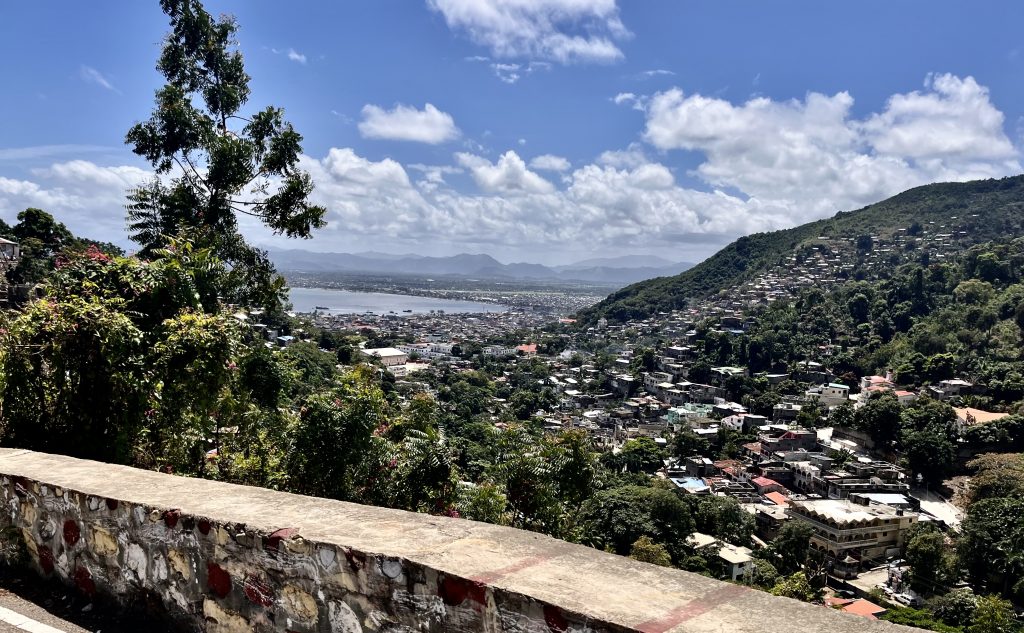
When traveling to Haiti, my heart always skips a beat when the door to the airplane shuts tight and the propellers start to whirl. At that point, even before take-off, I’m mentally in Haiti. In the time it takes for the ferry to reach North Caicos from Provo, the rugged, green mountains of the north coast of Haiti seductively peak through the clouds, a world away from TCI.
After landing in Cap-Haitien, I notice the profusion of aircraft. The airport used to be rather sleepy with just a couple of planes on the tarmac. No longer. Jets, turbo props, single engine planes, and helicopters take up most of the parking. And that’s even after airlines from the US stopped flying in.
The reason for the busy tarmac is plain: No international carriers fly into Port-au-Prince. Only the Haitian airline, Sunrise Airways, along with a couple of UN and government chartered helicopters take the risk. The danger posed by gangs, now controlling 80-90% of Port-au-Prince, has also led most non-government organizations (NGOs), international businesses, and many foreign and government offices to relocate to Cap-Haitien. The busy Cap-Haitien airport affirms the dramatic shift in the country’s economic power and center of gravity from south to north. And, as I would learn, fueling Cap-Haitien’s status as the hub of Haiti, if not the de facto capital.
The airport arrival terminal also reflects a transformation that I had not expected. It used to be dark and musty. Now the terminal is clean, well-lit, and amazingly efficient. Immigration has stopped using paper forms for passengers to fill out. Instead, everyone is given an app to upload on their phones to provide information with a bar code.
Yes, Haiti, a country always tagged with the last name “poorest country in the Western Hemisphere, is on the cutting edge of high-tech application for airport arrivals. Moreover, helpful airport agents who speak excellent English provide patient assistance to anyone who needs it.
A Haitian friend picked me up outside the terminal to take me to the Hotel Roi Christophe in downtown Cap-Haitien. I had driven along this road dozens of times and remembered seeing the swaths of garbage lining the route and even spilling out to the bay. Distressingly, the trash is still there. Like most western visitors to Haiti (or any developing country), I used to ask, “why don’t they get some bulldozers and big trucks and just…” But I stop myself. I am not here to judge, but to observe. It’s too easy and smug to think we, who do not live there, have all the answers to solve the problems based on a drive-by.
Ground Truth In Traffic
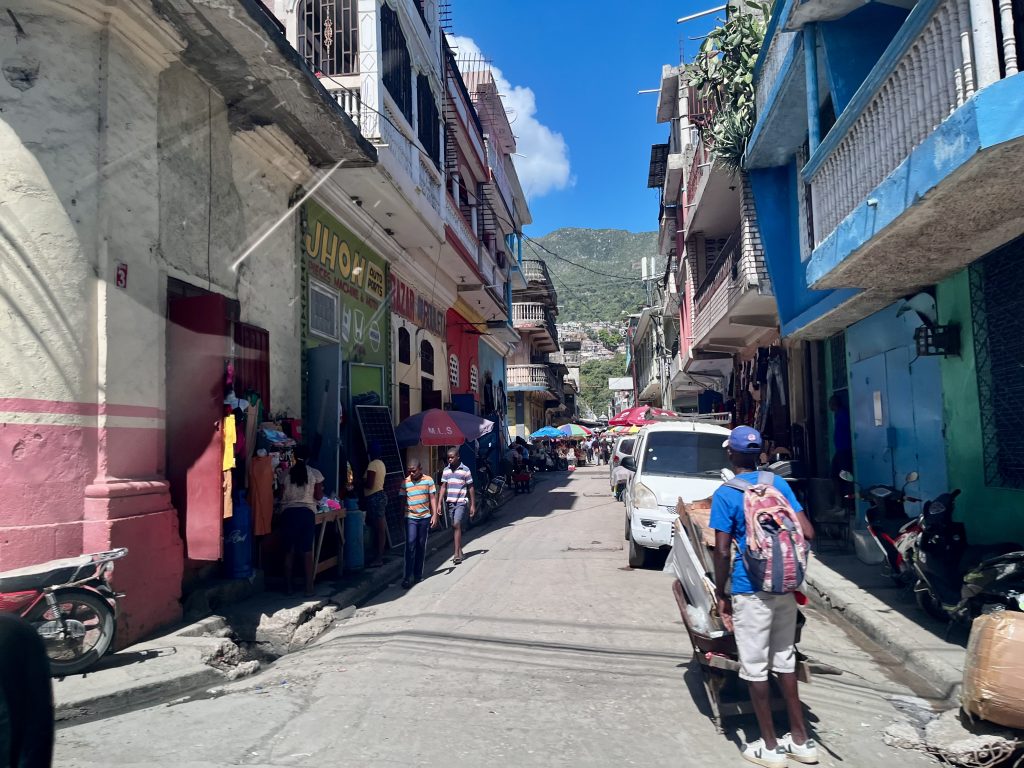
When my car approaches the city center, the trash tapers off, though piles show up here and there, and a cacophony of mass commerce comes into view. Endless stalls and tiny shops that sell everything from spices and fish to clothes and car parts cram together on the sides of the streets.
Traffic slows to a crawl with scores of tap taps (small trucks converted into minibuses), tuk tuks (three-wheeled motorized rickshaws from India) and mopeds (from China). They all compete for road space with new SUVs, banged up sedans, and huge Mac-trucks. Streets meant for two lanes of traffic morph into four or even five lanes of traffic. The mopeds, often carrying three or four kids, weave in and out like a choreographed ballet. The blare of horns, smoke from barbecue goat, and occasional plumes of exhaust fumes fill the air.
Not that different than when I was there before. Just more cars and people.
My friend tells me that Cap-Haitien’s population has roughly doubled over the last few years from a quarter million to around a half million as people have fled the crisis in Port-au-Prince. But the lively chaos displays a city that somehow functions anyhow and feels remarkably safe with no sign of gangs or even fear of gangs. Notably, I see no police officers or armed forces.
Art & Freedom / Past & Present

My car drops me off at the hotel that had once been the French governor’s mansion in the late 1700s. It still drips with old colonial ambiance—imposing arches allow the breeze to blow through while enclosed courtyards framed by thick walls create quiet sanctuaries.
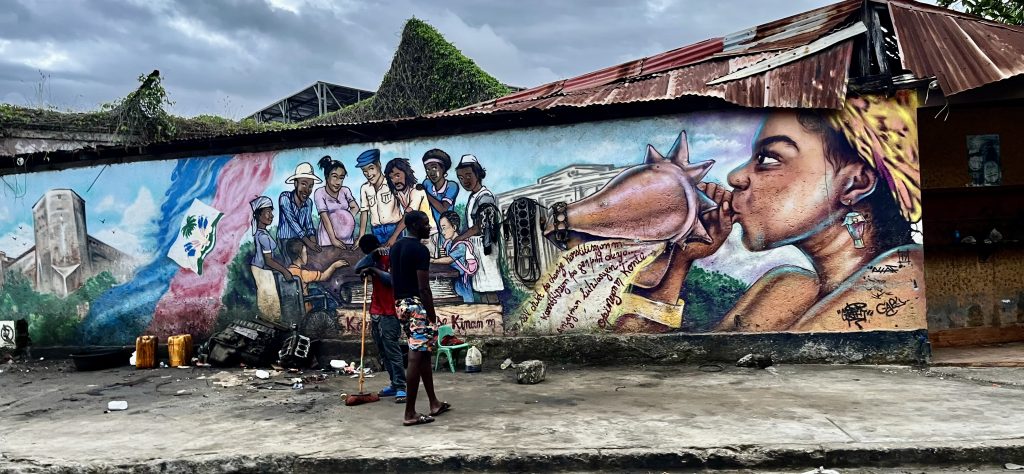
Haitian paintings adorn the walls of the Hotel Roi Christophe, all bursting with vibrant colors. Intentionally simplistic with flat surfaces and a lack of formal perspective, the artwork depicts serene scenes of everyday life—market ladies, mountain farms, and working sailboats. In Haiti, art mirrors life as the people live it, a fluid flux between physical and spiritual worlds.
Oddly, animals from Africa, like giraffes and lions, also fill canvases. I once asked a Haitian artist why they paint pictures of animals that do not exist in Haiti. He said “We paint those animals so we can dream of them when life is too hard.” I did not need to ask more.
Many of the paintings show famous Haitian generals gallantly leading troops in the revolution for freedom more than two centuries ago. For Haitians, those are not just scenes replicating historical events. Here the past fuses seamlessly with the present. The 12 year long slave revolt that won them freedom after a final battle in November 1803 forms the core of Haiti’s identity and pride. It is as if the revolution happened last week. The victorious enslaved changed the French name of the country from Saint-Domingue back to Ayiti (Haiti)— the original name of the country given by the indigenous Taino Indians. It means “sacred land of high mountains.”
As the second independent republic in the Americas and the first free Black republic, Haiti became a beacon for the enslaved escaping from other Caribbean islands—including TCI. In the 1820s and early 1830s before slavery was abolished in British colonies, the enslaved on Grand Turk and Salt Cay would sneak away at night and quietly push sailboats from the beach into the sea. As skilled sailors, these Turks Islanders set course for Haiti steering south by the stars to their freedom.
Today, of course, the flow of people escaping is in the other direction. The irony is not lost.
Paradox Of Cap-Haitien
On a walk outside the hotel, I see a calm community where people move about, carry on business, and speak freely without fear. A civility prevails in a city that seems to work, however fitful and patchy despite the poverty and overcrowding. All of which draw a sharp contrast to the brutal , intractable plight of Port-au-Prince.
Below the surface of the city’s bustle, however, an anxiousness lurks. It is not obvious to the casual visitor who sees a pervasive and healthy hustle. But my friend tells me that more Haitians see no future in the country that struggles to break the economic malaise.
Many Haitians used to flee by air to a South or Central American country where they did not need a visa. But as travel restrictions tightened, that door has nearly closed. The other far more precarious option is to take a chance on a boat packed with 100 or 200 migrants bound for Turks & Caicos, Bahamas, and in some cases the United States. The price may range from $2000-$3000 for a one-way trip depending on the quality of the vessel and whether it has a motor. On a moonless night when the seas look calm, nervous migrants gather on a north coast beach. After a brief Vodou ceremony, they clutch their grisgris talisman for protection and shove off from the shore. They know full well they may drown during crossing.
At the same time, other signs point to hope. I spoke with a banker and learned that Cap-Haitian banks lend money to hotel and apartment construction projects while visiting investors from the Haitian diaspora search for opportunities. At the port, shipping containers pile up waiting for trucks to deliver them to buyers that indicates no economic slow-down.
The majority of Haitians in the city dress well, almost never ragged, and children appear neat in their uniforms as they dash off to school. While acute food insecurity looms over Haiti, no one looks hungry or sick except for street urchins who come out of the shadows to beg. But they pose no threat.
The restaurant scene thrives with plenty of live Kompa and Zouk music every evening of the week. I had an excellent dinner and a local beer at a popular cafe called Cap Deli on the waterfront. A park in the center of the city brims with young and old gathering to chatter and laugh all through the day. Many stay well into the night.Remarkably, the power never goes off while I was there.
On the way back to the airport, I come across one more telling scene. A fist-fight breaks out between a couple of young men. Neither of them pulls a knife or a gun. Two police officers, the first I had seen the whole trip, rush out from a side street and drag the men apart. The police do not use batons or other weapons and quickly deescalate the confrontation.
That short, dramatic incident, which I catch on video, further exposes the other side of Haiti—a universe away from the intractable plight of Port-au-Prince. The people of Cap-Haitien have their own code for keeping the peace. Police step in when needed but otherwise remain largely invisible. I let that trait sink in.
What to make of this paradox of two conflicting truths playing out at the same time in Cap-Haitien? Call it the real world, where quandary, contradiction and complexity constantly confound–except that in Haiti the edge cuts sharper and the stakes climb higher.
My takeaway: We must not dismiss Haiti with superficial labels that fail to capture the nuances and disparities. To do so risks reinforcing the stereotype of the entire country as a basket-case and ignoring the fortitude of a people who don’t just to survive, but thrive even when hope is in short supply. Cap-Haitien shows the more promising face Haiti and richly deserves to be in the spotlight.
One town, one neighborhood at a time
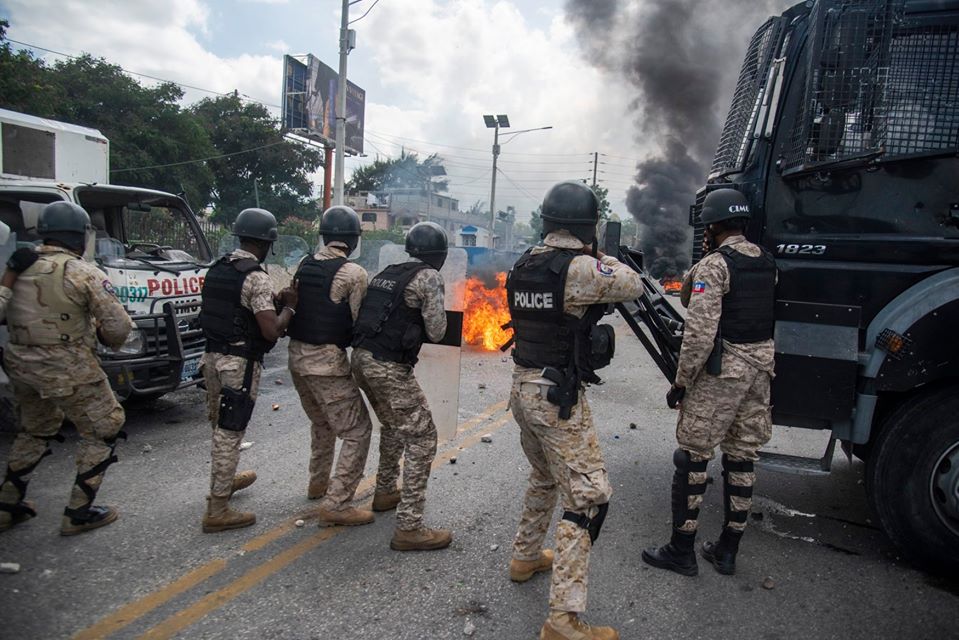
Since President Jovenel Moïse was gunned down almost five years ago, gangs, have steadily tightened their grip on Port-au-Prince. Despite valiant efforts by the Haitian National Police and Armed Forces and the presence of foreign troops, gangs now control 90% of the city.
Moreover, gangs continue to consolidate their significant gains through alliances, the largest of which is Viv Ansanm (Live Together). They still ruthlessly exploit and enforce their will on the population under their control, often in partnership with the Haitian elite who have traditionally controlled much of the economy.
At the same time, the gang alliances are evolving to become players in the political arena. They now seek influence over future governance and even a measure of legitimacy. With newfound wealth from narcotics, human, and gun trafficking, along with extortion and kidnapping, the gangs have power and leverage.
The impact of gang control is staggering. Gangs in Port-au-Prince killed 800 people in the first nine months of 2025. They caused the displacement of 1.4 million people–10% of Haiti’s population. Violence against women and girls escalated to 6000 cases in the first six months of 2025. 6.4 million people, more than half the population, currently needs humanitarian support. (International Rescue Committee/Watch Report January 2026)
The horrific havoc and terror wreaked by gangs on Haiti and Port-au-Prince in particular has instilled a deep anger among Haitians who sometimes form their own anti-gang vigilante squads known as Bwa Kale.
Time for a new strategy to counter the domination of united gangs
The Haitian police and army have largely battled the gangs in their neighborhood strongholds from inside the capital. Sometimes the Haitian police and army kill gang members, force them to retreat, and score a victory. But often the gangs will return. The playbook needs to be flipped. Haitian police and army, along with foreign military support, need to start attacking gangs from outside the city and working their way in toward the center.
Until now, approaching gangs from outside the city would have been difficult as the police and army would have been thinly spread. Only around 1000 Haitian police and army actively engage in combat against the gangs, together with some 1200 foreign troops in the city. But with the UN authorized (US supported) “Gang Suppression Force” numbering 5500, Haiti has an opportunity to try a different approach that presents a better chance of victory. The first 1500 troops of the Gang Suppression Force, all from Chad, arrive in April.
While the Gang Suppression Force is welcome news, it is imperative that these new foreign troops be used to augment and support Haitian police and army already fighting. Not the other way around. As noted in previous postings, the effort to crush gang control in Port-au-Prince must be led by Haitians. Historically, foreign forces have marched in with a “we know best” mentality that has sidelined Haitians, often resulting in ruinous outcomes. If that happens again, the Gang Suppression Force will fail.
No one can discount the deep complexities of gang influence and operational capabilities that often equal the police and army. But hitting the gangs in the towns and neighborhoods on the outskirts of Port-au-Prince where they have less control and thus more vulnerable has the best chance prevailing.
For this approach to succeed, Haitian and foreign forces must develop and agree to a meticulous plan that lays out the tactics and follow-up step by step. And they must anticipate and prepare for in advance the necessary infrastructure to secure neighborhoods and towns liberated, including economic stimulus and social services.
16 steps to defeat the gangs and take back control
Step 1. Set up a “Combined Command” Center where Haitian and foreign forces can plan and coordinate operations, collect and disseminate intelligence, and jointly evaluate success and setbacks
Step 2. ID towns and neighborhoods on the outskirts of Port-au-Prince to the north and east where gang influence and power is weakest. Prioritize engagement with gangs accordingly.
Step 3. Game out various scenarios to anticipate gang responses. Prepare countermeasures as well as logistical support requirements
Step 4. Advance incrementally on one town or neighborhood at a time using heavy firepower. Also use psychological operations to confuse and demoralize gang leaders
Step 5. Secure the town or neighborhood and immediately bring in food and medical aid, including trauma support. Open transport corridors, hospitals, schools, and markets that allow people to resume normal life as much as possible
Step 6. Publicize the success through social media when gangs are pushed out and highlight the benefits of gang removal.
Step 7. Advance to the next town or neighborhood deemed vulnerable and take with overwhelming force. Continue to rack up small but significant wins while pushing remaining gangs members deeper into the city until they are surrounded
Step 8. Detain and interrogate gang members captured. Give lower level gang members, often young teens and even pre-teens forced to fight, amnesty and a second chance in accordance with Haitian law. Set up transition centers to facilitate reintegration into society for young offenders. Prosecute the senior gang leaders, as well as anyone charged with committing violent crimes, and jail them if found guilty
Step 9. Reestablish town and neighborhood councils with local leaders so they are empowered to resume municipal services (with assistance) and determine their own future
Step 10. Encourage people who have fled gang controlled areas to return so they can resume life with protection of Haitian and foreign forces. Provide assistance to ease the transition and leverage the experience of human rights organizations
Step 11. Give paying jobs to people to clean up liberated towns and neighborhoods along with micro loans for residents to restart businesses.
Step 12. Train a small security force of local residents to assist law enforcement with patrols and work with local council to keep gangs from returning
Step 13. Engage US Coast Guard and coast guard units from other nations to work with the Haitian Coast Guard to inspect all incoming ships for contraband. Ensure legitimate cargo offloaded is not delivered to gangs or elite allies
Step 14. Isolate gangs into smaller areas while offering inducements to surrender as Haitian and foreign forces move house to house to root them out
Step 15. Put in place monitoring systems (through the Combined Command) to quickly detect and respond to any reemerging gang activity
Step 16. Implement a longterm plan to recruit, train and equip 5000 – 10,000 additional Haitian police officers and army soldiers to replace the Gang Suppression Force and prevent gang resurgence in Port-au-Prince and other parts of Haiti
Recap
The best way to beat the gangs is to take back the towns and neighborhoods they currently hold, one at a time. Pick towns where gang strength is minimal for visible wins followed by immediate assistance for people. Gradually move toward the center of Port-au-Prince with the objective of squeezing gangs into submission.
At the same time, return liberated areas to as much pre-gang normalcy as quickly possible. Also, make provisions for transitioning children used by gangs, treating victims harmed, and vigorously prosecuting violent gang members and their elite enablers.
A foreign Gang Suppression Force can give Haitian police and army the necessary firepower support to clear gangs from territory they control. But Haitian police and army must lead the way to build local confidence and encourage cooperation for longterm success that puts the nation on a path to recovery.
https://www.rescue.org/uk/article/haitis-gang-violence-crisis-what-know-and-how-help

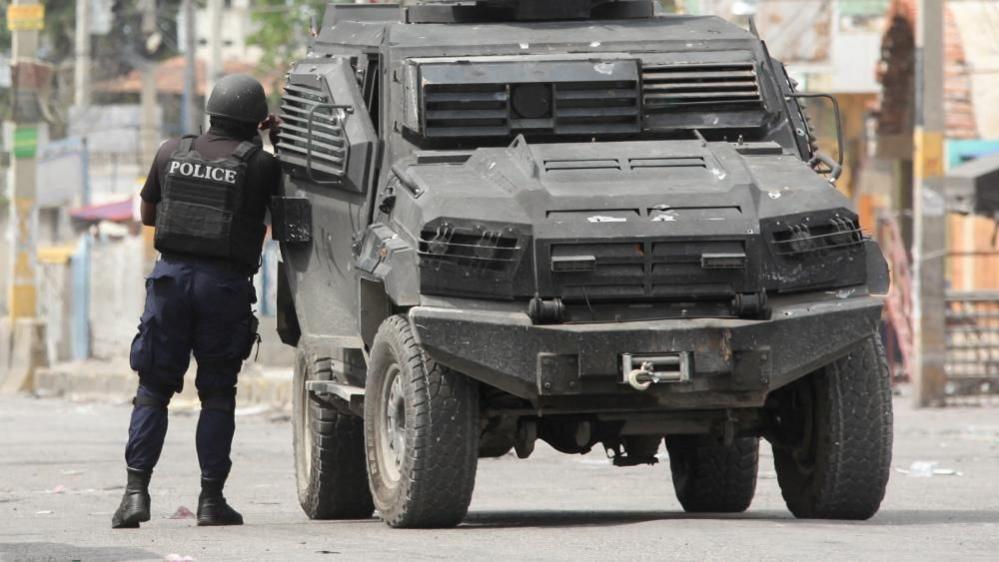
In a desperate attempt to stave off complete gang takeover of Port-au-Prince, the Interim Haitian Government has contracted with private foreign security forces. These well-armed, occasionally well-trained, and often reckless hired guns are supposed to support the Haitian National Police and Army. But it is unlikely they will be able to contain the gangs or save the government’s tenuous toe-hold on less than 10% of the capital. The foreign private security forces may actually exacerbate the problem.
The most recent addition to the private security providers is Erik Prince, founder of the notorious Blackwater Worldwide private military contracting company that massacred 17 civilians in Iraq in 2007. Blackwater was dissolved, but rebranded itself under a new company, Constellis, offering similar services.
According to the New York Times, Mr. Prince is sending 150 “mercenaries” to Haiti. The dollar amount for the contract is not known, but it is likely in the tens of millions in order to pay the mercenaries and their equipment for their stint in Port-au-Prince, as well as ensure a healthy profit for the company. One can only surmise, but the mercenaries may be earning as much as $100,000 for a year on the job.
Compare that to the roughly $200 per month or $2400 per year that the Haitian National Police officers are receiving to put themselves on the line and face death every day. The roughly 400 Haitian Army soldiers deployed in the capital and facing the same dangers receive even less pay. That huge disparity for essentially the same work can only have a demoralizing effect on the Police and Army.
Both Haitian security forces and foreign contract security forces are using drones in an effort to target gang leaders. So far, they have not been successful, but innocent civilians have been killed in the process. If the foreigners kill innocent Haitians through drone attacks (or firefights), gangs will almost certainly use the casualties as propaganda to frame their struggle as a national liberation from foreign invaders to gain popular support. In any case, there will be little accountability for the actions of the mercenaries.
Meanwhile, the gangs themselves have attempted to purchase their own drones, most recently through the Dominican Republic. The DR has long served as a pipeline for arms to gangs in Haiti despite DR government efforts to stem the trade. Should the gangs in Port-au-Prince actually obtain drones and deploy them against Haitian police, army and foreign mercenaries, it will be a game changer and further redefine the nature of modern armed conflict, as it has in other parts of the world.
Some private security firms, including Mr. Prince’s, have reportedly attempted to hire Haitian-American military veterans to go to Haiti as security contractors/mercenaries to enhance familiarity with Haitian language and culture. But many Haitians with military skills have resisted being drawn in because they don’t want to be linked with notorious foreign mercenaries who are not welcomed and largely unaware of fast moving developments in Haiti. If anyone understands what’s going on with the gangs in Port-au-Prince, it’s the Haitian National Police and Army who face off with them almost every day.
Regardless, the mercenaries, along with the Kenyan and Jamaican troops currently deployed, won’t be enough to defeat the gangs, especially if the gangs are able to employ attack drones against them. The gangs already possess powerful assault weapons that match what their opponents have.
The foreign private security companies will certainly make a lot of money from their mercenary services regardless of how the tide of the conflict swings. And, once again, Haiti will become a place for foreigners to generate cash off of Haiti’s misfortune.

As the gang alliance, Viv Ansanm, threatens the last remaining sections of Port-au-Prince still under government control, we need to ask: What will a complete takeover look like? From this Haiti observer’s perspective, we are likely to see criminal city-state emerge. What I have called a “gangocracy”—the rule by gangs. Here’s how it could go down.
—Gangs take over and destroy Digicel facility in Port-au-Prince. This disrupts communications for 3.7 million people. Natcom Mobile, the other major provider, might still function for 4 million people. But almost half the population would be affected. The sharply reduced service would not affect most gangs since they are connected with Starlink.
—The remaining Interim Government of Haiti officials still in the city leave by helicopter and set up offices in Cap-Haitien, which has already become the de facto capital of Haiti. Indeed, government officials have been frequenting Cap-Haitien for months now (as well as cities in the south like Les Cay). Fortunately, the officials can use a helicopter operated by the Taiwanese that has been ferrying them back and forth from the capital. So everyone knows the route, even as shots are taken at the helicopter.
—Morale of the National Haitian Police at various stations around Port-au-Prince will fall. They will question why they are the only ones left behind to fend for themselves.
—As gangs tighten the noose around Port-au-Prince, they will lay siege to police stations and maybe attack them. The police may hold off for a while, but then, perhaps after a shoot-our, surrender with terms that could allow them to drive away freely and safely from the city with their families.
—The Kenyan and other foreign troops will have no incentive to fight and leave after negotiating some deal for safe passage. A UN plane would be deployed to pick them up at the airport (opened for this short window) and fly them to the US or another Caribbean nation or even back to Kenya.
How Will Foreign Countries React?
The spectacle of complete gang dominance will be humiliating. People will be asking, how could a ragtag band of gangs (albeit well-armed) kick out police as well as professional soldiers (also well-armed)? There will be a lot of fretting among foreign government officials about what to do next. One option being discussed is having the Organization of American States (OAS) put together a foreign military mission to try to confront and dislodge the gangs from Port-au-Prince. The reason to go through OAS is to avoid calling for a vote in the UN for more forces, which would likely be vetoed by Russia and China. Plus, OAS is not set up for armed force deployment. So this to won’t materialize.
In short, little appetite for another foreign intervention, which will leave the gangs in power.
Gangocracy Governance?
The international inaction will give the gangs a clear victory and put them in control of the capital. But the gangs have not put forth a plan for governing. In fact, it seems they have little interest in setting up a government.
Rather, they would prefer to exert power and influence through intimidation, while also using the opportunity to amass more money and arms to remain in control. They will want everyone to know that they call the shots. In other words, it’s a giant ego trip. In fact, the leader the gang “5 Segon,” Johnson Andre, aka “Izo,” fancied himself as a rap star. He often posted video on TikTok until his account was shut down. Other gang leaders enjoy showing off their cash on TikTok.
The lack of ambition beyond wealth and personal power could lead to an opulent lifestyle where gang leaders and their lieutenants take advantage of abandoned villas in and around Port-au-Prince. The gangs would likely play to the common people by branding themselves as the ones who defeated the foreign invaders and liberated the city. They might allow back some foreign medical teams to restart clinics and aid agencies to ship in food, as hunger is becoming acute with the prospect of famine. Down the road, gangs may even seek some recognition and legitimacy as a power to be reckoned with. But only if they can keep the loose alliance going.
Complete gang take-over also opens the door to narco-traffickers seeking to expand using a safe base. In that sense, control of the capital can further enhance the wealth of gang leaders and entrench their power. At that point, the city-state gangocracy will be complete and serve as an entity that defies the rules of diplomacy and the concept of the nation-state.
Of course, there is also the possibility that the alliance will collapse and the gangs fight among themselves over turf, especially if there is not common enemy. That would, of course, only deepen the suffering of the people left behind in Port-au-Prince. The disease and famine triggered by a war among the gangs could well be catastrophic with little relief from aid agencies.

Making the Case for Building Up the Haitian Army to Fight The Gangs
With the brutal gang killing of 70 people in the Artibonite Valley 50 miles north of Port-au-Prince last week, it is clear the security situation in the capital region is worsening. According to the UN Human Rights report, the “Gran Grif” gang used automatic weapons in a shoot-out with police and others that also killed 10 women and 3 infants. This horrific event unfortunately reveals the ineffectiveness of the foreign troops in Port-au-Prince (mainly the 400 Kenyan soldiers) to reduce the violence. Indeed, it shows that the UN and foreign governments are going about it wrong, and that a different solution is required.
The quality of the Kenyan troops (or the troops from Jamaica and other countries) is not at issue. Nor is there any want for logistics. The Kenyans are well-armed and live in high quality and very comfortable American-provided barracks near the Port-au-Prince airport. The problem, to state the obvious, is that the Kenyans are not Haitian. And because of that, they have no knowledge of the local culture, perceptions, or environment, and little understanding of the nature of gangs in Port-au-Prince. Moreover, the foreign troops generally don’t have much incentive to engage gangs who are armed with the same firepower, quite entrenched, and experienced in shootouts with police.
In past blogs I have noted how some gangs, despite their brutality, have become more effective in co-opting the local population with food, medicine and security. This, of course, is making gang eradication even more difficult, especially since the gang leaders frame the conflict as “us” Haitians against the foreign invaders.
Indeed, the foreign troops do not have the broad confidence of the Haitian population, whether or not in gang controlled areas, and therefore will receive little if any support. The whole idea of bringing in foreign troops comes with a familiar whiff of the foreign presumption that “we” can best handle this best, not the Haitians. That one-dimensional and shortsighted approach has always failed, as it did in the previous UN peacekeeping mission (known as MINUSTAH) that spent 13 years (2004 – 2017) trying to stabilize Haiti.
The only realistic alternative is to greatly expand the Haitian Army (Forces Armées d’Haiti or FAd’H). The Haitian Army currently has less than 2000 personnel. That number needs to be significantly increased to around 10,000 to be effective. Many potential and highly motivated recruits stand ready to join. If the UN or the U.S. and other nations really want to be part of the solution, they can help to train and equip those troops and even create an elite force among them. In time, Haiti could have a first rate military that, together with the Haitian National Police, could quash gangs and garner internal pride and respect.
Now, is there a risk that someday the military will stage a coup and install a ruthless military dictatorship (as happened in 1991)? Of course, but that risk is present in just about every developing country and even some developed countries around the world. The potential benefits of stabilization and security far outweigh the risk of a coup d’etat. This is the time to be bold and not let unknowable possibilities hold back a good chance to achieve order in Haiti.
Until Haiti develops a strong military capability, none of the other pressing issues in Haiti can be effectively addressed: health care, economic and infrastructure development, restoration of a justice system, and holding secure elections. All of these problems will continue to linger, including the displacement of 700,000 people due to gang violence. And when people feel safer and more protected , they will have less of a reason to flee Haiti and more of an incentive to stay and rebuild the country.
A strong Haitian army could also work with fire and rescue units to better prepare Haiti for natural disasters and play a key role in recovery after disasters strike. A Haitian army could be deployed to stem drug and gun trafficking through Haiti.
In short, a larger, better-equipped, and well-trained army is the only realistic option to give Haiti the best chance. Outsiders can give Haiti that chance, not by trying to fix things themselves, but by recognizing that Haitians can take care of their own problems better and lending them a hand.