Tell someone you are going to Haiti for a visit and watch the eyes cringe and the nose scrunch at the wisdom of your decision. Indeed, the word Haiti typically conjures up visions of gang violence and tragic catastrophes. An unsafe place in perpetual poverty and filled with people desperate to escape. In short, a country to avoid. That is, after all, how TV, social media, and government advisories portray Haiti. And so that is the way most people think of Haiti–forlorn, pitiful, and one dimensional.
All the more reason for me to see for myself how Haiti is doing. So, I hop on the twin engine plane for a short 40 minute flight to Cap-Haitien 100 miles south of Provo.
Now, I have been to Haiti many times over the past 30 years, so I am somewhat familiar with the country. I used to support the Cap-Haitien Fire Department with equipment and training (including swim instruction). I also helped to arrange annual visits for an American surgical team. I even took people on private tours from TCI to Northern Haiti. Those trips gave me an on-the-ground perspective of the country.
But the last time I was there was in 2019. Since then Haiti had gone through profoundly hard times, including the assassination of its President, Jovenel Moïse in 2021. Shortly after he was killed, gangs took over of most of Port-au-Prince. Today, the ruthless gangs have sadly become the face of Haiti while Cap-Haitien remains in the shadow.
Time for an update to get the real story.
Returning Impressions
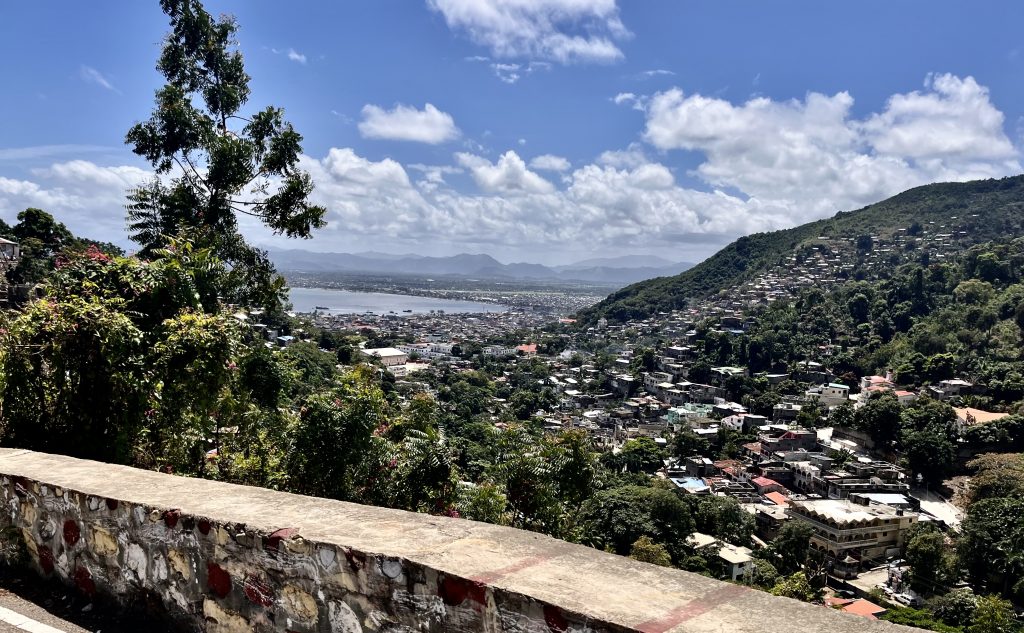
When traveling to Haiti, my heart always skips a beat when the door to the airplane shuts tight and the propellers start to whirl. At that point, even before take-off, I’m mentally in Haiti. In the time it takes for the ferry to reach North Caicos from Provo, the rugged, green mountains of the north coast of Haiti seductively peak through the clouds, a world away from TCI.
After landing in Cap-Haitien, I notice the profusion of aircraft. The airport used to be rather sleepy with just a couple of planes on the tarmac. No longer. Jets, turbo props, single engine planes, and helicopters take up most of the parking. And that’s even after airlines from the US stopped flying in.
The reason for the busy tarmac is plain: No international carriers fly into Port-au-Prince. Only the Haitian airline, Sunrise Airways, along with a couple of UN and government chartered helicopters take the risk. The danger posed by gangs, now controlling 80-90% of Port-au-Prince, has also led most non-government organizations (NGOs), international businesses, and many foreign and government offices to relocate to Cap-Haitien. The busy Cap-Haitien airport affirms the dramatic shift in the country’s economic power and center of gravity from south to north. And, as I would learn, fueling Cap-Haitien’s status as the hub of Haiti, if not the de facto capital.
The airport arrival terminal also reflects a transformation that I had not expected. It used to be dark and musty. Now the terminal is clean, well-lit, and amazingly efficient. Immigration has stopped using paper forms for passengers to fill out. Instead, everyone is given an app to upload on their phones to provide information with a bar code.
Yes, Haiti, a country always tagged with the last name “poorest country in the Western Hemisphere, is on the cutting edge of high-tech application for airport arrivals. Moreover, helpful airport agents who speak excellent English provide patient assistance to anyone who needs it.
A Haitian friend picked me up outside the terminal to take me to the Hotel Roi Christophe in downtown Cap-Haitien. I had driven along this road dozens of times and remembered seeing the swaths of garbage lining the route and even spilling out to the bay. Distressingly, the trash is still there. Like most western visitors to Haiti (or any developing country), I used to ask, “why don’t they get some bulldozers and big trucks and just…” But I stop myself. I am not here to judge, but to observe. It’s too easy and smug to think we, who do not live there, have all the answers to solve the problems based on a drive-by.
Ground Truth In Traffic
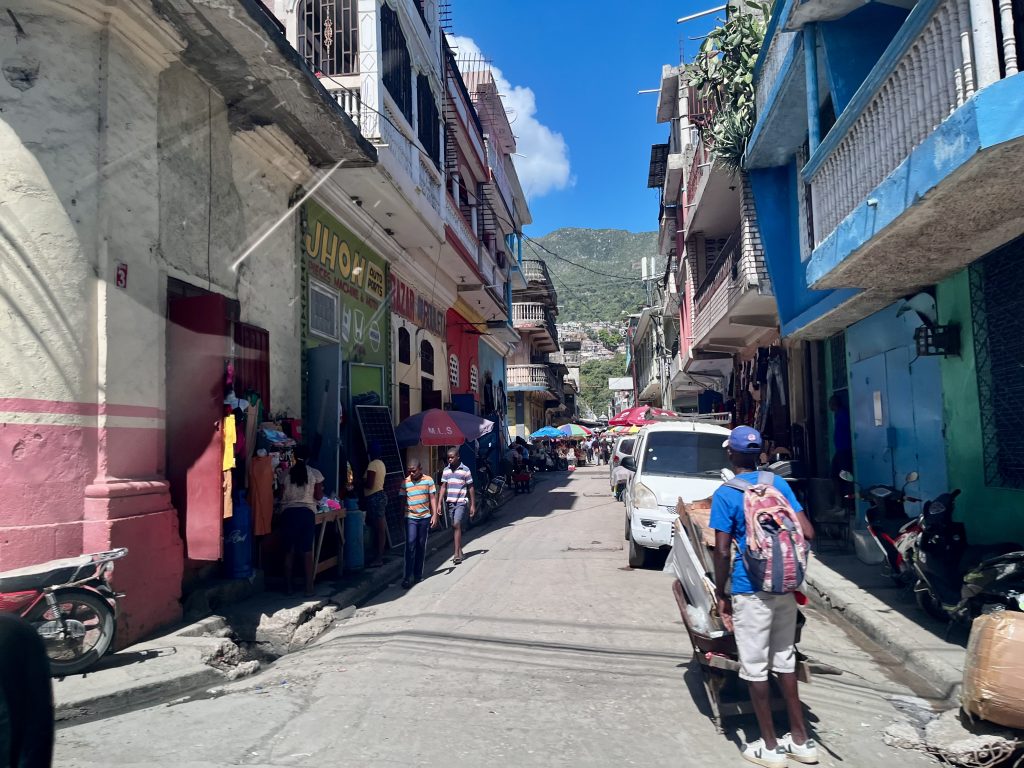
When my car approaches the city center, the trash tapers off, though piles show up here and there, and a cacophony of mass commerce comes into view. Endless stalls and tiny shops that sell everything from spices and fish to clothes and car parts cram together on the sides of the streets.
Traffic slows to a crawl with scores of tap taps (small trucks converted into minibuses), tuk tuks (three-wheeled motorized rickshaws from India) and mopeds (from China). They all compete for road space with new SUVs, banged up sedans, and huge Mac-trucks. Streets meant for two lanes of traffic morph into four or even five lanes of traffic. The mopeds, often carrying three or four kids, weave in and out like a choreographed ballet. The blare of horns, smoke from barbecue goat, and occasional plumes of exhaust fumes fill the air.
Not that different than when I was there before. Just more cars and people.
My friend tells me that Cap-Haitien’s population has roughly doubled over the last few years from a quarter million to around a half million as people have fled the crisis in Port-au-Prince. But the lively chaos displays a city that somehow functions anyhow and feels remarkably safe with no sign of gangs or even fear of gangs. Notably, I see no police officers or armed forces.
Art & Freedom / Past & Present
My car drops me off at the hotel that had once been the French governor’s mansion in the late 1700s. It still drips with old colonial ambiance—imposing arches allow the breeze to blow through while enclosed courtyards framed by thick walls create quiet sanctuaries.
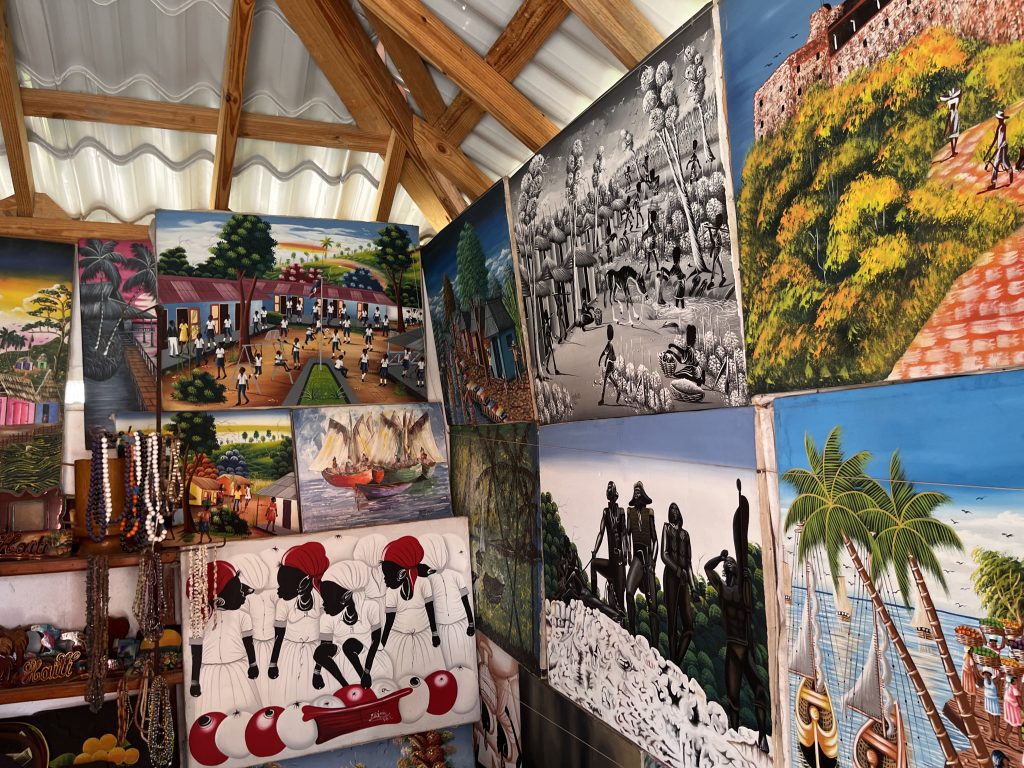
Haitian paintings adorn the walls of the Hotel Roi Christophe, all bursting with vibrant colors. Intentionally simplistic with flat surfaces and a lack of formal perspective, the artwork depicts serene scenes of everyday life—market ladies, mountain farms, and working sailboats. In Haiti, art mirrors life as the people live it, a fluid flux between physical and spiritual worlds.
Oddly, animals from Africa, like giraffes and lions, also fill canvases. I once asked a Haitian artist why they paint pictures of animals that do not exist in Haiti. He said “We paint those animals so we can dream of them when life is too hard.” I did not need to ask more.
Many of the paintings show famous Haitian generals gallantly leading troops in the revolution for freedom more than two centuries ago. For Haitians, those are not just scenes replicating historical events. Here the past fuses seamlessly with the present. The 12 year long slave revolt that won them freedom after a final battle in November 1803 forms the core of Haiti’s identity and pride. It is as if the revolution happened last week. The victorious enslaved changed the French name of the country from Saint-Domingue back to Ayiti (Haiti)— the original name of the country given by the indigenous Taino Indians. It means “sacred land of high mountains.”
As the second independent republic in the Americas and the first free Black republic, Haiti became a beacon for the enslaved escaping from other Caribbean islands—including TCI. In the 1820s and early 1830s before slavery was abolished in British colonies, the enslaved on Grand Turk and Salt Cay would sneak away at night and quietly push sailboats from the beach into the sea. As skilled sailors, these Turks Islanders set course for Haiti steering south by the stars to their freedom.
Today, of course, the flow of people escaping is in the other direction. The irony is not lost.
Paradox Of Cap-Haitien
On a walk outside the hotel, I see a calm community where people move about, carry on business, and speak freely without fear. A civility prevails in a city that seems to work, however fitful and patchy despite the poverty and overcrowding. All of which draw a sharp contrast to the brutal , intractable plight of Port-au-Prince.
Below the surface of the city’s bustle, however, an anxiousness lurks. It is not obvious to the casual visitor who sees a pervasive and healthy hustle. But my friend tells me that more Haitians see no future in the country that struggles to break the economic malaise.
Many Haitians used to flee by air to a South or Central American country where they did not need a visa. But as travel restrictions tightened, that door has nearly closed. The other far more precarious option is to take a chance on a boat packed with 100 or 200 migrants bound for Turks & Caicos, Bahamas, and in some cases the United States. The price may range from $2000-$3000 for a one-way trip depending on the quality of the vessel and whether it has a motor. On a moonless night when the seas look calm, nervous migrants gather on a north coast beach. After a brief Vodou ceremony, they clutch their grisgris talisman for protection and shove off from the shore. They know full well they may drown during crossing.
At the same time, other signs point to hope. I spoke with a banker and learned that Cap-Haitian banks lend money to hotel and apartment construction projects while visiting investors from the Haitian diaspora search for opportunities. At the port, shipping containers pile up waiting for trucks to deliver them to buyers that indicates no economic slow-down.
The majority of Haitians in the city dress well, almost never ragged, and children appear neat in their uniforms as they dash off to school. While acute food insecurity looms over Haiti, no one looks hungry or sick except for street urchins who come out of the shadows to beg. But they pose no threat.
The restaurant scene thrives with plenty of live Kompa and Zouk music every evening of the week. I had an excellent dinner and a local beer at a popular cafe called Cap Deli on the waterfront. A park in the center of the city brims with young and old gathering to chatter and laugh all through the day. Many stay well into the night.Remarkably, the power never goes off while I was there.
On the way back to the airport, I come across one more telling scene. A fist-fight breaks out between a couple of young men. Neither of them pulls a knife or a gun. Two police officers, the first I had seen the whole trip, rush out from a side street and drag the men apart. The police do not use batons or other weapons and quickly deescalate the confrontation.
That short, dramatic incident, which I catch on video, further exposes the other side of Haiti—a universe away from the intractable plight of Port-au-Prince. The people of Cap-Haitien have their own code for keeping the peace. Police step in when needed but otherwise remain largely invisible. I let that trait sink in.
What to make of this paradox of two conflicting truths playing out at the same time in Cap-Haitien? Call it the real world, where quandary, contradiction and complexity constantly confound–except that in Haiti the edge cuts sharper and the stakes climb higher.
My takeaway: We must not dismiss Haiti with superficial labels that fail to capture the nuances and disparities. To do so risks reinforcing the stereotype of the entire country as a basket-case and ignoring the fortitude of a people who don’t just to survive, but thrive even when hope is in short supply. Cap-Haitien shows the more promising face Haiti and richly deserves to be in the spotlight.
Leave a Reply